May 19, 2014
Through the Vicissitudes of History: Beginning with Huang Shiqing's Running Script Couplet Stele
Text/Yan Qiuxia
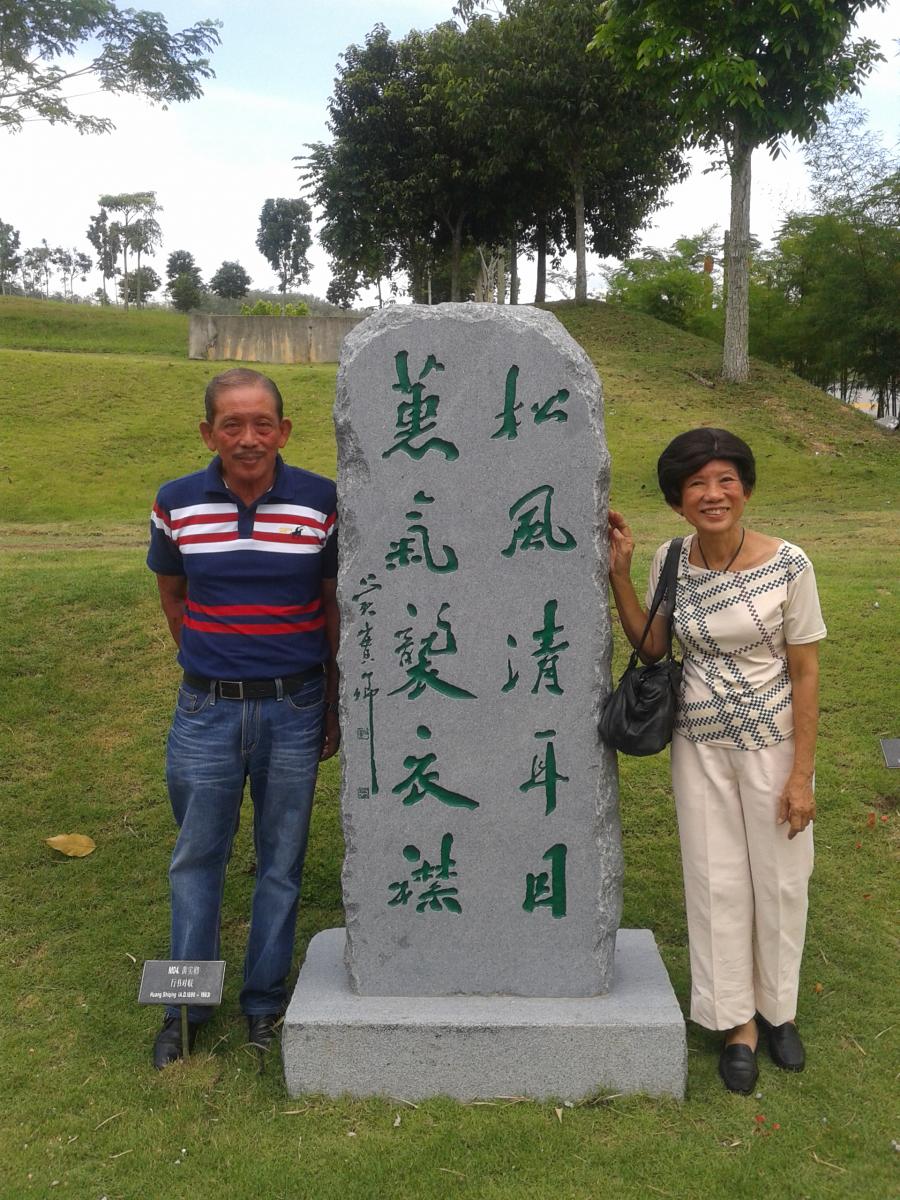
In today's era of widespread computer use and three-dimensional images, the value and culture preserved through the lines of calligraphy inscriptions have gradually become alienated from life, and even make people feel strange. Each work in the "Local Stele Forest" of the "Chinese Humanistic Stele Forest" is provided by calligraphy collectors, family members or related units. In the process of collecting authentic works, the author realized the importance of the "stele" as a carrier. The works selected by calligrapher Huang Shiqing for erecting the monument are:
The pine breeze clears the ears and eyes, and the refreshing air hits the lapels of clothes.
When the author received the calligraphy treasure from Huang Shiqing's granddaughter Huang Naixin in 2012, she recounted her experience in the aftermath of this work: When the May 13th Incident occurred, the family lived in Kampung Baru and was in a state of emergency. The whole family was in a hurry and took nothing with them. When I returned to the original location three days later, I found that the house had been completely devoured by the fire, and most of the ink stains and collections had been burned. Only a dozen pieces of calligraphy in two iron boxes remained, among which the rice paper showed signs of being smoked. The smoke stains were faded only after the work was re-framed. For a long time, officials have described the "May 13th Incident" that occurred on May 13, 1969 as an "ethnic conflict incident" in favor of the government's position. Many families were separated during this tragedy, and the older generation has a shadow over this matter. The truth still needs to be reinterpreted by those who are interested, and I believe that the other side of history needs to be restored. Such a story reflects a great era, a family's experience with heirlooms.
Huang Shiqing (1890 AD - 1963 AD), a native of Puning, Guangdong, was known as "Jiangxia Bozi". He was admitted as a Chaozhou scholar and came to Kuala Lumpur in his prime. In 1923, he initiated the establishment of Pei Chai School in Kuala Lumpur and served as the first principal. He also initiated the organization of the Teochew Association of Malaya. He often wrote inscriptions on temples, Taoist temples and schools, or business treasures and ancestral halls, such as: "Climbing the other shore", "Khun Seng Girls' School", "Selangor Teochew Pattaya Association", and was a member of the Nanyang Calligraphy and Painting Society. His calligraphy master, Zheng Banqiao, is one of the pioneer calligraphers in my country. His running script is elegant, smooth and self-contained.
In 2011, Long Xue Huatang held the "Wonderful Ink Drops - Huang Shiqing Memorial Calligraphy Exhibition", regrouped the works under one roof, and published "Huang Shiqing Calligraphy Collection". Granddaughter Huang Naiming, who is over 70 years old, describes it in her book "My Grandfather": "My grandfather is an elegant and quiet scholar who likes to write poems and calligraphy. He grew flowers and raised fish. Because he didn't like social interaction, he would write in the small house in the morning. My brothers and sisters often helped him polish the calligraphy. My grandfather was an upright man, and I admired Yan Zhenqing and Zheng Banqiao most for their chivalrous spirit and their love for marriage. To the literati... If it had been ten years later, our generation who had lived with my grandfather might have left the world. By then, his calligraphy works would have been reduced to ashes, and his story would only be known by the word ‘Huang Shiqing’.” However, the ancestors have already passed on the culture by erecting monuments. Because of this carrier, it proves his status in the local calligraphy community and also gives the oral legend stories a reliable basis.
The monument, as a heavy carrier, can condense the style of an era. Scholars of literature and history can start with the content of the carved text, and calligraphers can study the aesthetic value, brushwork, and structural characteristics of the inscription. This carrier depicts the tension of time with its strength that remains unchanged and adapts to ever-changing circumstances. The "Cuan Baozi Stele" in the Stele Forest in China's past dynasties is a stone stele legend that has achieved immortality despite the vicissitudes of life. This Jin Dynasty stone tablet was erected in 317. Cuan Baozi was the prefect of Jianning. The inscription records his life, family history and political achievements. The Cuan family is a major ethnic minority in southern China. They were influenced by Han culture and imitated the Han people in setting up monuments and biographies. This stone carving was discovered by a farmer in his farmland in 1778 and became an important tool for grinding tofu in his family's tofu shop for 74 years. In 1852, Deng Erheng, a Jinshi who was proficient in epigraphy and calligraphy, discovered that the handwriting printed on the tofu was unusual. He became the Bole of this monument. After tracing it, he bought it and placed it in the Wuhou Temple in Qujing City for people to admire. In 1927, when the Yunnan warlords were fighting, the stone tablets were sent to the frontline battlefields as materials to build city walls and block bullets. Zhang Shiyuan, who made a living by selling the inscriptions on the stele, discovered that the stele was missing. He went to the construction site late at night to look for it. When he found it, he immediately moved it back home and put it on his bed to protect the stele from the fire of war. In 1937, a stele pavilion was built in Qujing No. 1 Middle School for protection; in 1989, it was expanded into a museum.
With reference to the "Stele Forest of Chinese Past Dynasties", the "Stele Forest in Local Areas" records 37 calligraphers who were active in Southeast Asia between 1874 and 1940. Although the year is short, it fills the gaps in the history of Nanyang calligraphy. During this period, photography replaced painters' portraits. Black-and-white and color photos were collected in photo albums. The photos were then stored in computers and burned into CDs, and then shared in photo albums on Facebook. This is a qualitative and quantitative shift in the experience carrier of our generation. However, no matter how a moment of memory is captured in the future, the characteristics of the inscription culture from ancient times have not been replaced. More importantly, when Chinese history is a neglected historical image in the current education system, the culture of stone tablets plays this role appropriately. The diversity and richness of this carrier are self-evident.
The original article was published in the supplement of Nanyang Siang Pau on May 19, 2014
Other Activities
其他活动回顾
Selected recent activity records by theme.
Visitor Records
Ceremonies
Cultural Activities
Malaysia Chinese Calligraphy Stone Gallery