April 7, 2014
Reunion: Memories of the Nanyang University Alumni Association of Malaya Visiting the Stele Forest
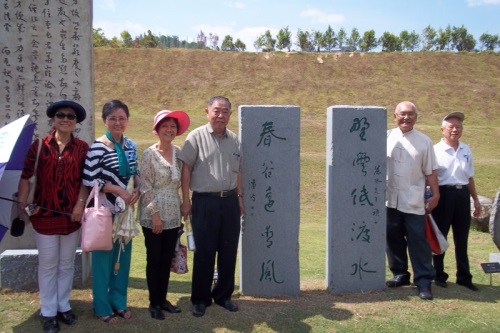
When the consultants of the Stele Forest, Mr. Chen Jiancheng, Mr. Wang Jieying and Dr. Foo Yonggang knew that a group of 50 people from the Nanyang University Alumni Association of Malaya would visit the Stele Forest on March 6, they all had no hesitation to receive them in person. Many students from 50 years ago are now in their seventies. As NTU alumni, Teacher Chen and Teacher Wang both called them seniors when they saw this group of alumni. The joy of seeing each other after a long separation was beyond words. Teacher Chen, who is also a calligrapher himself, introduced it this way: "The Stele Forest is the record of the first generation of local calligraphers. If you take a trip here, I believe everyone will feel more familiar with this area." The first monument is Tan Kah Kee's calligraphy work. We have not forgotten that the "Kah Kee spirit" of ruining the family and building a school was inherited by the founder of NTU, Tan Lark Sye.
Milestone in the history of Chinese education
During the British colonial period, "Nanyang University" gathered the blood and sweat of ordinary people from all over the world. In order to establish a university to cultivate Chinese children, everyone stepped forward without hesitation: tricycle drivers donated their bicycles, barbers donated their scissors, construction workers donated a day's hard work, fishermen donated their catch from the sea... and it was built. This concept allows children in Nanyang to continue their studies, which is a milestone in the history of Chinese education.
The rise and fall of Nanyang University is a microcosm of the history of Chinese education in Singapore: from its establishment in 1953 to 1958, through its struggle for degree recognition from 1959 to 1974, to restructuring, and then to its deterioration and closure from 1975 to 1980, it was the hard work of one generation in just 25 years. Nanjing teachers and students are all participants in this history. No matter how vigorous it was at the time, Yunnan Garden is not the campus of the past. From a young boy to starting a family and starting a business, the personnel changes involved have long been out of the question.
When walking along the way to the monument of Kong Xiangtai, the president of the NTU Alumni Association, Miu Jinxin, said: "Ah! This is the witness of my parents' marriage." This made everyone in the audience smile knowingly. When walking past the monument of Li Xiutian, someone said, "This is my teacher!"... When walking to the monument of Pan Shou, it resonated even more with NTU people.
The voices of the book-keeper and the visitor intersected in the stream of time, indicating that they had truly existed in each other's lives. Pan Shou was originally from Nan'an, Fujian, and his original name was Guoqu. He once served as editor of Lat News, principal of Sinochem Secondary School in Muar, Johor, and secretary-general of the Chinese Anti-Japanese War Nanyang Refugee Relief Association (the then chairman was Tan Kah Kee). After the Lin Yutang scandal, he was entrusted by the NTU Executive Committee headed by Chen Liusheng to serve as the Secretary-General when NTU was still struggling to grow. He supported the university through a difficult period of four years without a principal in charge of school affairs. He did not resign until the first batch of 437 students graduated in 1959. It is said that the "Declaration of the Establishment of Nanyang University" was drafted by him.
The ups and downs of career are closely connected with NTU
The Declaration states the four major reasons for the establishment of NTU: (1) to open the door to further education for high school graduates, (2) to train teachers for high schools, (3) to cultivate specialized talents for the country, (4) to meet the needs of the population; and two major characteristics: (1) to communicate Eastern and Western cultures, and (2) to develop Malayan culture. Pan Shou was deprived of his citizenship rights because of his active involvement in Chinese education. However, he has an uncritical attitude towards life towards all the injustices in the world. Every Friday, Saturday, and Sunday, Pan Shou would go to the Chung Hwa Bookstore in Singapore to gather with friends, drink tea, and write as he pleased to give away. His citizenship was restored in April 1983. In 1994, he was awarded the Medal of Merit by the President of Singapore, and in 1998, he was awarded an honorary doctorate. The ups and downs of his career were closely linked to NTU, and it was precisely because of his intellectual integrity that he maintained an elegant attitude even when he was lonely.
Yang Jinrong, consultant of the Stele Forest, has collected many works of his mentor, and specially selected this couplet with the title "Mr. Lishui Yazheng": "The clouds are low in the wild, the wind is far away in the spring valley across the water", which best reflects the portrayal of "let everything take its course". This work also records the friendship between Chen Lishui and Pan Shou. Mr. Chen is a Pontian native and a naturalized Singaporean. He is a construction contractor. He is interested in literature and art and has many friends with literati. At that time, the government wanted to demolish the gate of "Nanyang University". Although Tan Lishui received the project bid, he was unwilling to destroy it. This kind of thinking reflects that people from all walks of life are helpless in the face of power, but they still protect Nanyang University deep in their hearts.
Make the world full of warmth
Understanding the warmth and warmth of the predecessors from past events shows that everyone has thoughts of truth, goodness and beauty in their hearts, and through their own ways, the world continues to be filled with warmth. In the early days of NTU, the young people of the era felt the mission of caring about the country, and gradually expanded their concern for the local area. Although NTU is no longer here, the cohesiveness of the Alumni Association has attracted the world and has far-reaching influence. Under the dim dusk, it is rare for old classmates to still get together and talk about common things. What’s more, I didn’t expect that my old acquaintance Jiu Yu, who I had met in different periods, would reunite in the garden of “Malaysian Chinese Humanity Stele Forest”. Your words to each other were just right, showing the collective memory of an era that is very thought-provoking; what arose in my heart was the attachment to excellent traditions and the expectation for cultural progress.

Other Activities
其他活动回顾
Selected recent activity records by theme.
Visitor Records
Ceremonies
Cultural Activities
Malaysia Chinese Calligraphy Stone Gallery