October 17, 2013
Remembering People Through Objects, Feeling Deeply Close to Them
--Starting from Principal Wang Miwen and Yan Qiuxia
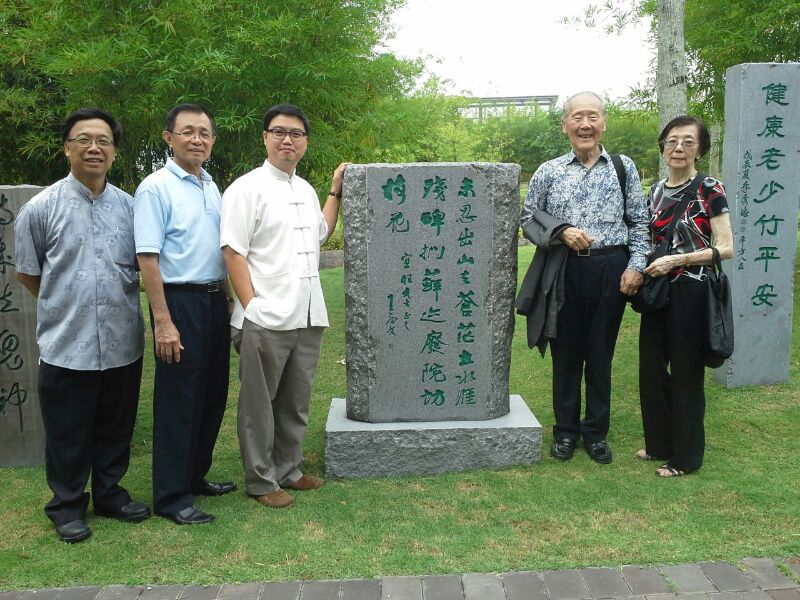
This time, the Forest of Chinese Humanities Monuments welcomed Professor Wang Gungwu, the eldest son of President Wang Miwen, his wife and a group of 13 scholars. This was a post-conference trip arranged after the "Eighth Academic Conference of the World Society for the Study of Overseas Chinese" (ISSCO 8) organized by the Institute of Chinese Studies at the University of Torahman. Professor Wang Gungwu is a well-known historical scholar today, with knowledge of both China and the West. At the conference, Professor Wang’s bilingual speech was concise but profound, deeply attracting the attention of the participants. His voice is condensed in time and space. Professor Wang was also awarded the "Lifetime Achievement Award" at the meeting. Professor He Qiliang arranged for Professor Wang to visit the Stele Forest after the meeting and said, "I hope you will see your father's calligraphy monument." Professor Wang readily agreed.
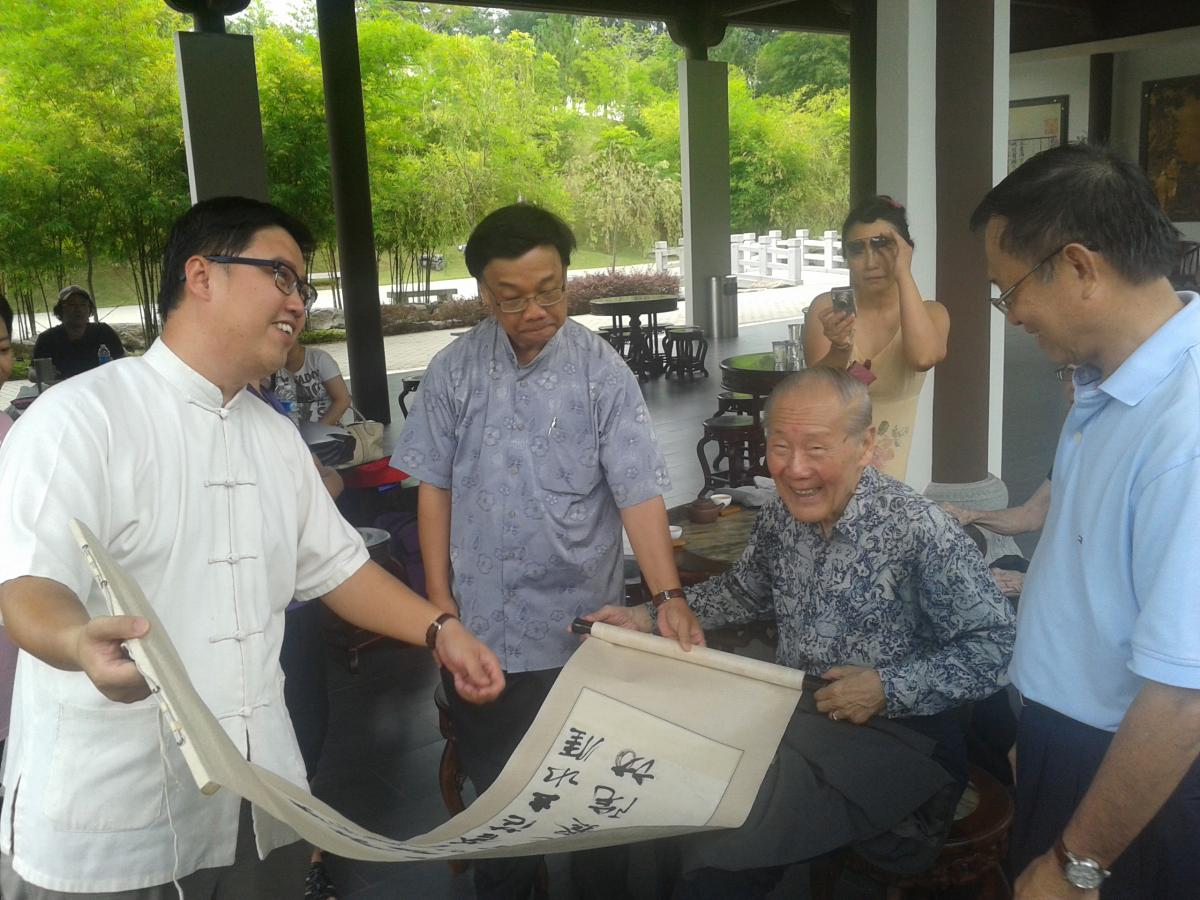
On August 19, 2013, under the leadership of Dato Hu Yaqiao, Chairman of the Stele Forest Management Committee, a group of scholars visited the Stele Forest together. Along the way, Professor Wang Gungwu recalled various things about his father, saying that his father would practice calligraphy for 1-2 hours every day after dinner. Principal Wang Miwen specializes in calligraphy, and is particularly good at small seal script. He admires "Yan Zhenqing" and emphasizes that "a correct heart means a correct pen", which reflects the requirements of scholars since ancient times for their character. What the family collected were all calligraphy works without signatures, so they did not leave any calligraphy as family heirlooms. Principal Wang is modest and thinks that his calligraphy skills are not good enough to be recognized as an elegant person, and he does not have much handwriting left. For Professor Wang, he was particularly surprised that the steles listed in the "Chinese Humanistic Stele Forest" could actually collect calligraphy written by his father. During the conversation, the calligrapher Yang Jinrong who was traveling with him immediately took out the original calligraphy of Principal Wang Miwen that he had collected for a long time. This running script banner is:
"I can't bear to go out of the mountains. The vast expanse of water stands. The ruins of monuments are covered with moss traces. The abandoned courtyard visits the plum blossoms."
Professor Wang carefully looked at his father's calligraphy, and his feelings of longing for people after seeing things were clearly revealed.
Since poems, books, rituals and music can be passed down from family to family, why does it have to be collected by one’s own family? For Principal Wang, who does not take his own calligraphy seriously, the steles engraved in the Stele Forest are his calligraphy gifts to his friends. This approach is the true character of a scholar. This work was written by Mr. Peng Yiwang in his early years in Johor Bahru before he was going to teach in Sabah. He asked the then Principal Wang to write it for him. Mr. Peng later transferred the calligraphy treasure to Yang Jinrong and it became one of his collections. Mr. Yang then recommended it to be included in the local Stele Forest.
Wang Miwen (1903-1972) was born in China. He successively worked at the Overseas Chinese High School in Singapore, Zunkong High School in Kuala Lumpur, Peifeng, Malacca, and Surabaya, Java. From 1959 to 1968, he was the principal of Huanrou High School, and finally settled in Johor Bahru. In the preface of "Wang Miwen Memorial Collection" compiled by Professor Wang Gungwu, it is written: "My father devoted himself to the glorious cause of Chinese school education in Singapore and Malaysia, and considered himself very lucky. Although he could not return to his hometown, he could still achieve his lifelong ambition. What satisfied him most was the ten years at Huan Rou Middle School. On the one hand, he could help MCA's independent high school education system become a social force, and on the other hand, he had the opportunity to establish the modern educational ideals that he had always valued."
When the independent middle school was facing restructuring, he, Chairman Xiao Wanxiang and other people who insisted on mother-tongue education took the lead in announcing that Huanrou Middle School was the first independent middle school in the country not to accept restructuring, which has had an impact to this day. Coincidentally, Mr. Xiao Wanxiang’s inscription stands diagonally opposite to Principal Wang’s work. Since the local Stele Forest is arranged according to the birth year of the calligraphers, the works of "Clan Soul" Lin Lianyu and "Clan Hero" Shen Muyu are also nearby.
Principal Wang is different from the "soul of the clan". Mr. Lim Lian Yuk's struggle has always been outside the system. Principal Wang speaks fluent English and once served as the inspector of Chinese schools in Perak. He became a bridge of communication with the British colonial government within the education system. After the war, he was promoted to the inspector of Chinese education in the Ministry of Education of Malaya after the war. After retirement, he became the principal of Kuan Middle School. It is worth mentioning that the “national hero” Mr. Shen Muyu is a student of President Wang. Dr. Li Qianyao's "Shen Muyu's Regular Script Shape - Compatibility of Regular Script Standards and Calligraphy Style" by Dr. Li Qianyao records that under Wang Miwen's teaching, Shen Muyu studied "Shuowen Jiezi", understood the academic principles of the "Six Books", and formed his view of Chinese character form.
Everything you walk through will leave traces, and through the inscriptions, you can continue to pass on your personal vitality. This carrier is a carrier for calligraphers to move from private collections into the public domain; for the Chinese community, the "local Stele Forest" presents the epitome of the history of Chinese education. This trip is rich in experience. Through the story of the second generation of this scholarly family, we, as juniors, can not only travel with Professor Wang Gungwu and his wife in the Stele Forest, but also reminisce about the life of Principal Wang Miwen. Following this historical corridor, it also leads us to re-understand the cultural landscape of the Chinese education industry in the past.
Other Activities
其他活动回顾
Selected recent activity records by theme.
Visitor Records
Ceremonies
Cultural Activities
Malaysia Chinese Calligraphy Stone Gallery