October 27, 2014
Tan Kah Kee: A Model Confucian Merchant in the Stele Forest
Text/Yan Qiuxia
The original article was published in the supplement of Nanyang Siang Pau on October 27, 2014
The works in the "Local Stele Forest" area collected in the "Chinese Humanistic Stele Forest" were written by principals, teachers, calligraphers and painters, literati, and entrepreneurs of the last two generations. "Calligraphy" is a very common thing for the elders who often use writing brushes, and the written content naturally presents the style of a generation. Today, this has become an art that can not only cultivate our temperament, but also allow us to connect with ancient culture. Calligraphy and inscriptions have become a treasure of Chinese culture, which contains rich cultural and historical information and reveals the authenticity of history.
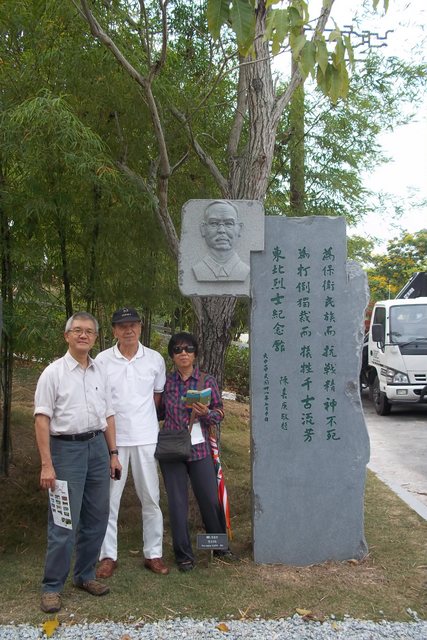
All works in the local Stele Forest area are arranged in order of the birth year of the writer. The first monument at the entrance is the work of Tan Kah Kee. This "first" combines multiple representative positions: a typical Confucian businessman, an educator, a former chairman of the Association of Overseas Chinese in Southeast Asia to Relieve Refugees from the Motherland, an overseas Chinese leader in Southeast Asia, the founder of Nanyang Siang Pau, and the founder of Jimei University and Xiamen University in China. Tan Kah Kee (October 21, 1874 - August 12, 1961) was a native of Jimei Society, Tong'an County, Fujian. His life spanned the late Qing Dynasty, the Republic of China, and the founding of New China. He was praised as an "overseas Chinese hero." His works include "Memoirs of Nanqiao" (1946), "Collected Comments of Nanqiao" (1949), etc. His calligraphy is round and natural, with the charm of Yan Zhenqing's "Magu Immortal Altar". This regular script engraved on a monument reflects his personal experience of China's internal and external troubles, which inspired his patriotic enthusiasm and sense of social responsibility:
The spirit of fighting to defend the nation will never die
Sacrifice to overthrow dictatorship and live forever
Northeastern Martyrs Memorial Hall, inscribed by Tan Kah Kee on July 10, 1938, the Republic of China
Education is the foundation of a country
Although he lived in Malaya when he was young and made many achievements in the new generation of enterprises and education in Malaya, Tan Kah Kee still identifies with his hometown. As an overseas Chinese leader, Tan Kah Kee was engaged in rubber, pineapple and other industries in Malaysia and Singapore. After he became successful, he generously donated money and returned to his hometown to run education businesses. He was known as "ruining a family to build a school." He believes that "the prosperity of a country depends entirely on its people, and the development of its people depends entirely on education, which is the foundation of a country." The Jimei school he founded forms a school village from kindergarten to junior college.
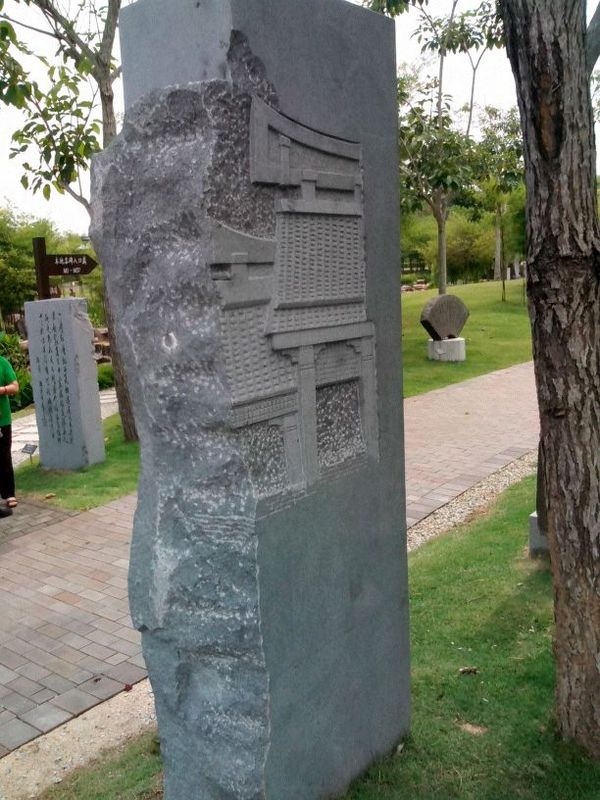
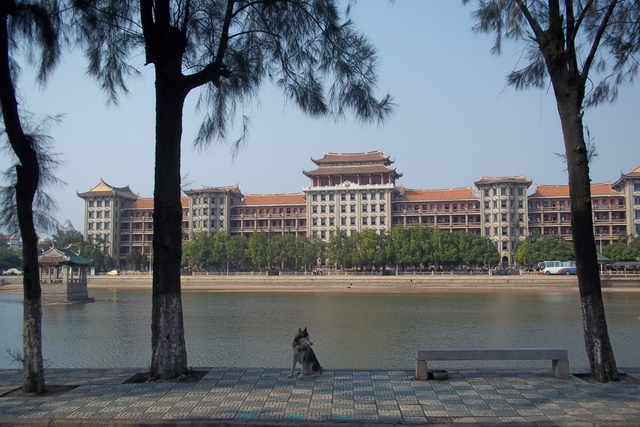
In October 2012, when the author went on a cultural trip to southern Fujian with teachers and students from the Chinese Studies Institute of Universiti Tunku Abdul Rahman, the tour guide Huang Yulin explained: "In the era when Tan Kah Kee grew up, he faced the invasion of Western colonial forces, but he still emphasized that 'Chinese learning is the mainstay and Western learning is used.' This spirit is reflected in the architecture of Western-style high-rise buildings and Chinese-style pagoda roofs. Every school building in Jimei Meisei Village is of this style. The clever thing is that Wang Longhai, the senior arts and crafts artist who undertook the Chinese Humanistic Stele Forest project, graduated from Jimei University founded by Tan Kah Kee. Based on the emotional identification with him, we designed a monument that combines calligraphy and a corner of the Jimei University campus, so that this monument can more specifically present the spiritual connotation of his life and events.
Promote civilian education
In August 2014, Tan Kah Kee’s grandson Dr. Fu Shujie and his friends Ye Hanyuan and Chen Yueqing visited the Stele Forest. Dr. Fu said humorously, "Because there are so many children and grandchildren in the family, my grandfather doesn't remember me very well." Dr. Fu, who is over 80 years old, was born during the British colonial era and graduated from the Medical School of the University of Malaya in Singapore. When he was young, communication at home was in Hokkien. He was educated in English, so he did not appreciate his grandfather's calligraphy. I have known about my grandfather's deeds from my grandmother and elders in the family since I was a child. It turns out that Tan Kah Kee's investment in education was wishful thinking at the beginning. Jimei Primary School had a complete school building and teachers in the early days of its establishment, but on the first day of school, there were not even a single student. He soon realized that the students were not coming to class because all the children needed to go to the beach to collect oysters to earn money to support their families. In order to implement his educational ambitions, the industrialist did not hesitate to pay 2 yuan per semester to attract children to study in school. Jimei Primary School started operating under such circumstances. Tan Kah Kee advocated civilian education. In the second year after the establishment of Jimei Primary School, he opened a "popular night school" and set up a "newspaper reading room" to promote popular education for adults.
The influence has not diminished to this day
This persistence in education was put to the test when he failed in business. Some people advised him to reduce funding for Xiamen University and Jimei University, but he said with great magnanimity that "I would rather close the building (enterprise) than support Xiamen University." Tan Kah Kee's corporate empire has disappeared since it declared bankruptcy, but his influence has not diminished to this day. His enthusiasm for education influenced Lee Kong Chian and Tan Lark Sye, making contributions to Chinese education in the region. This October is the 140th anniversary of his birth. Relevant units locally and in Xiamen have organized activities to promote his spirit. Tan Kah Kee’s life-long deeds were all about “industry, education, and nation-building.” This concept allowed the people I came into contact with during this period to interpret this model of Confucian businessman from multiple perspectives when remembering him.
Other Activities
其他活动回顾
Selected recent activity records by theme.
Visitor Records
Ceremonies
Cultural Activities
Malaysia Chinese Calligraphy Stone Gallery