Logo

Malaysia Chinese Calligraphy Stone Gallery

马来西亚
中华人文碑林

Home
About
ForewordCommitteeDiscover BeilinEvolution of Chinese CharactersCalligraphy AppreciationVisitor Feedback
GalleryDynastyEvents & DownloadsContact UsReservation
English
简体中文
English
繁體中文
日本語
Bahasa

Curated Collection

Curated Stillness

Let these collections be more than a display—let them be a wandering, a quiet gaze. Here, every stroke is a whisper of time, leading you into the boundless river of the written word.
Oracle Bone Script
Wei Stele Script
Regular Script with Semi-Cursive
Semi-Cursive Script
Li Shu, Kai Shu
Regular and cursive scripts
Cursive Script
Running script
Regular script
Big seal script
Xiaozhuan
Clerical script
Bronze Inscription
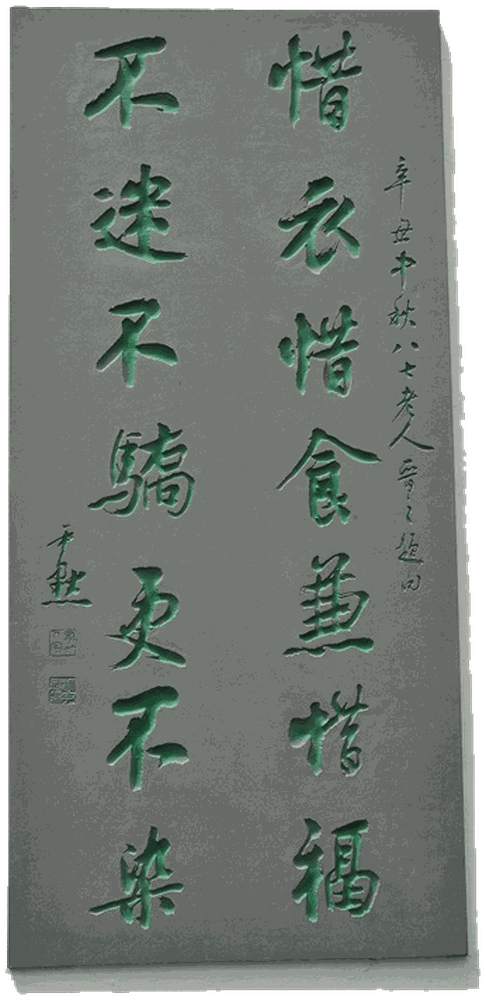
Li Da Ting: Xing Shu Couplet

Running script

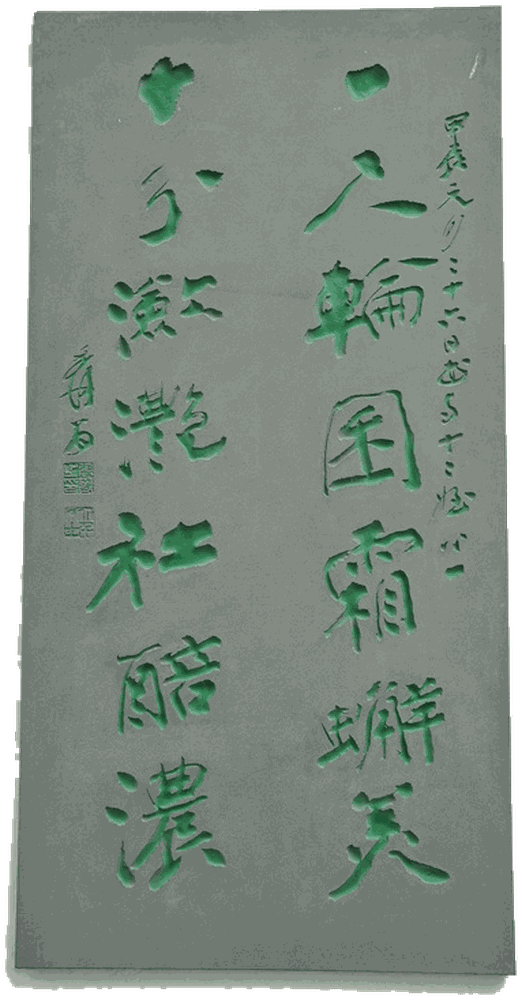
Li Da Ting: Xing Shu Couplet

Li Da Ting hailed from Guanghai, Taishan District, Guangdong Province. He was a distinguished calligrapher, member of Nanyang Calligraphy and Painting Association, and the inaugural secretary of United Chinese School Committees (Dong Zong). His big-script calligraphy on the signboards and ‘Xing Cao’ calligraphy formed part of the street scene in the old days’ Kuala Lumpur. Sultan Street’s historic signs such as the art and cultural centre of Yan Keng Benevolent Dramatic Association and the old folks-cum-funeral home Chik Sin Thong were penned by him. Li drew inspiration from Ming Dynasty’s calligrapher Dong Qi Chang, who is renowned for the epitaph or brief biographical sketch he wrote for Xiang Mo Lin’s funeral. Li’s calligraphy is very much driven by the ancient style that he admired. The characteristics of his calligraphy include the robust, thick yet elegant strokes deriving from a centrally-stroked technique. There are only a very limited number of works by Li in circulation today. This couplet was authored by him at the age of 90. It echoes the journey of his life through the seasoned brushstrokes. He certainly left a legacy of calligraphy art in his era, which today inspires the newer generations to draw inspiration from.

Qi Gong: Thousand-Character Essay in Cursive Script

Running script

Qi Gong: Thousand-Character Essay in Cursive Script

Qi Gong belonged to the Manchu family clan of Aisin Gioro, of the Yong Zheng emperor’s lineage started from the fifth son of the emperor, Hong Zhou. He was the eighth-generation great-grandson of the Hong Zhou. The ‘Cao Shu’ Calligraphy on ‘Qian Zi Wen’ (The One-Thousand-Word Cursive/ Grass Script) was authored by him in 1977 at the request of Jin Yu, an ardent literary arts collector. Qi Gong’s calligraphy mastery was sparked off by the prominence of Ouyang Xun, followed by that of Yan Zhen Qing, Dong Qi Chang, Zhi Yong and Liu Gong Quan. His calligraphy works manifest the calligraphy styles of the legendary Wang Xi Zhi and his son Wang Xian Zhi with influence from Yan and Liu’s schools of thought. His ‘Xing Shu’ calligraphy, however, bears a great deal of his very own characteristics. Qi Gong’s calligraphy works are mostly ‘Xing Shu’ driven. His ‘Cao Shu’ calligraphy works are very limited in circulation, therefore this particular exhibit is highly treasured and considered as one of the most famous ‘Cao Shu’ works by him.

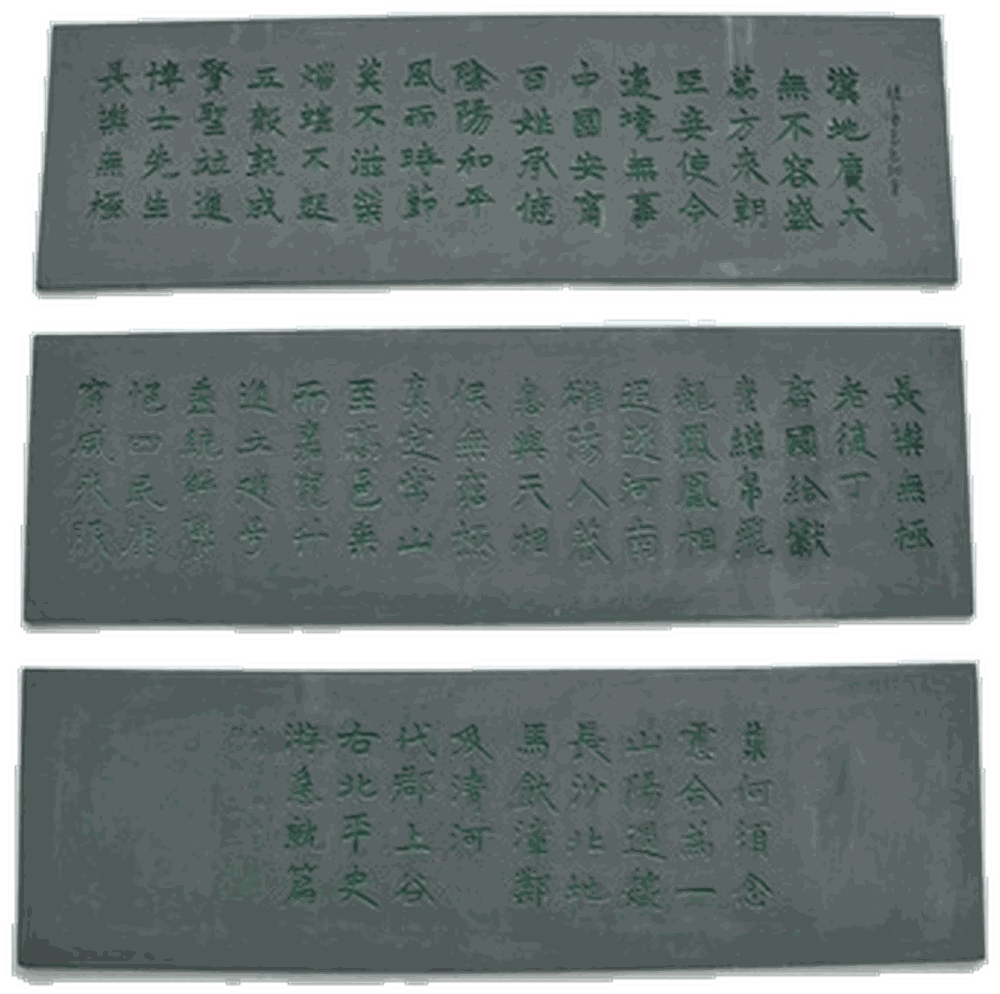
Sha Menghai: Excerpt from Sun Guoting's Treatise on Calligraphy

Running script

Sha Menghai: Excerpt from Sun Guoting's Treatise on Calligraphy

Sha Meng Hai was a top-notch calligrapher and literary figure in his era. The well-learned scholar is renowned for his in-depth knowledge of linguistics, literature history, archaeology, calligraphy and seal carving. His calligraphy was influenced by the ancient Han and Wei dynasties, followed by the Song and Ming dynasties. Sha cleverly fused the ancient and modern calligraphy to form a distinct calligraphy personality synonymous with him. He was adept at ‘Zhuan’, ‘Li’, ‘Xing’, ‘Cao’ and ‘Kai’ calligraphy. His calligraphy exudes the elements of vigour and grandeur. This special calligraphy mention on “Sun Guo Ting’s Calligraphy Theories” was authored by Sha at the age of 90. The work displays a very special appeal with tightly knit strokes and in fine feather, befitting the calligraphy personality of Sha.

Zhang Daqian: Xing Shu Couplet

Running script

Zhang Daqian: Xing Shu Couplet

Zhang Da Qian mastered his calligraphy from Li Rui Qing and Zeng Xi. He amassed his calligraphy knowledge from a number of different sources including that of Huang Ting Jian.  Zhang was particularly intrigued by Huang’s calligraphy style, which suggests unrestrained yet cultured strokes, with hints of adventurous spirit and peculiarity. Zhang’s calligraphy is perceived by scholars as very core-centric driven. Each character reaches out to all four corners with a balanced, rhythmic flow no matter how the stroke is swayed and that conjures up a mellow tone to the eyes. Zhang is best known for his ‘melancholy’ calligraphy technique on his favourite painting subject i.e. the weathered branches of a plum tree. It may look jaded at first glance, but the deeper you appreciate it, the more appealing it becomes. The overall profile of his calligraphy packs quite a punch as evidenced by the dynamism and fluid rhythm of his works. Zhang is still revered as a legendary painter until today. Nevertheless, his calligraphy bears a significant amount of fine elements of art and the artistic value associated with it, making his masterpieces much sought after.

Xu Beihong: Xing Shu Couplet

Running script

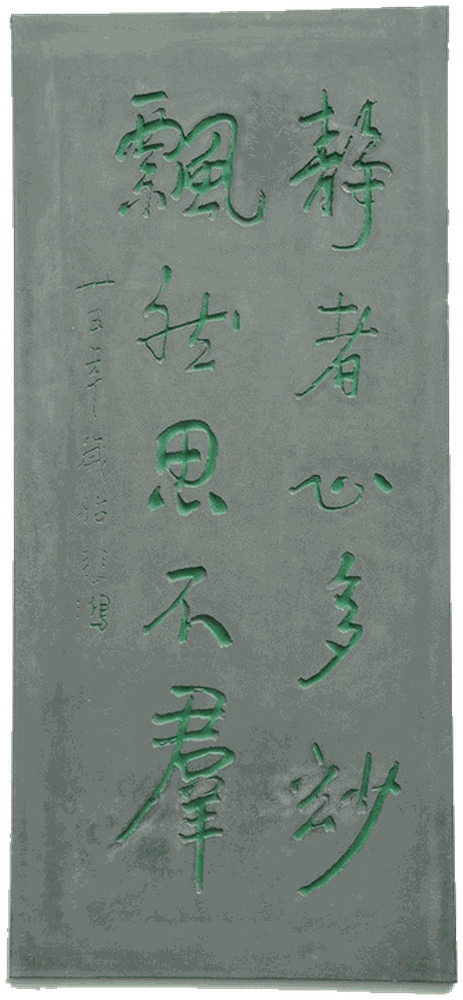
Xu Beihong: Xing Shu Couplet

Xu Bei Hong was a master of Chinese ink paintings, oil paintings and sketch drawing. Amazingly, he was one of the most distinguished Chinese oil painters of the modern era. One of his poetry masterpieces is the 5-word-sequenced couplet written in the ‘Ben Ma Tu’ (Galloping Horses) painting, which bears the meaning of ‘a man thinks more and deeper when he is calm and quiet’. The masterpiece was produced in Chong Qing, in 1945, after the surrender of Japan. It was a present to his friend, Sun Zhi Jiao. Xu had had earlier made several trips to Malaya and Singapore during Japanese invasion, raising funds through the exhibitions of his art pieces, in the name of charity. Subsequently, many of his showpieces circulated into this region. His calligraphy bears the hallmarks of Kang You Wei. He was passionate about the incised calligraphy of the Northern Dynasties. He loved to combine the essences of brush-written calligraphy and incised calligraphy into his works, harmoniously. His calligraphy may reveal hints of coarseness yet energetic, with thick-and-thin strokes in combination; well-trained and vigorous; natural and unrestrained; fluent and untrammeled, with harmonious twists and turns alongside robust strokes and artistic charms.

Tai Jingnong: Wang Mojie Poem

Running script

Tai Jingnong: Wang Mojie Poem

Tai Jing Nong was a critically acclaimed author and literature critic. He was a member of ‘Wei Ming She’ (transliterated as the Anonymous Association) in the early days of his uprising movement and had scholastic exchanges with the highly respected Lu Xün. Throughout his illustrious careers, Tai lectured at Fu Ren, Qi Ru, Shan Dong and Xia Men universities and Si Chuan’s Jiang Jin Teachers College. He later became a professor at National Taiwan University. Being a remarkable calligrapher and author, Tai’s calligraphy portfolio covers bronze inscriptions, stone inscriptions, tablet inscriptions and masterpieces of varied renowned calligraphers. He was a master of different calligraphy styles, from ‘Zhuan Shu’ to ‘Li Shu’, ‘Cao Shu’, ‘Xing Shu’ and ‘Kai Shu’. Tai was raised in a strict family where he had to learn the ancient poetry and calligraphy as a kid. In his quest for acquiring new knowledge beyond the literature world, Tai once felt demotivated by calligraphy and decided to halt his literary journey. During Japanese invasion, Tai retreated to a confined life. Feeling imprisoned by a strong sense of emptiness and wanting to escape the confines of the raging war, he picked up his calligraphy brush again. He polished his calligraphy with priceless guidance from Shen Yin Mo. His ‘Xing Shu’ calligraphy drew inspirations from Ni Yuan Lu and Shen Ceng Zhi. Tai also enjoyed a teacher-friend relationship with Hu Xiao Shi. Tai was a prolific literary contributor.

Shen Yinmo: Xing Shu Couplets

Running script

Shen Yinmo: Xing Shu Couplets

Shen Yin Mo, whose original name was Yin Mo, specialized in brush-written calligraphy and incised calligraphy (eg. on stones and other objects). He was one of the most notable Chinese calligraphers of the modern era. He earned his fame through brush-written calligraphy (paper-based calligraphy), initially. He took up incised calligraphy seriously at later stage and made his presence felt consequently. His scholastic life seemed to be blossoming once more as he approached his 50s. His ‘Xing Shu’ and ‘Cao Shu’ calligraphy works which carry the magnificence of the Mi Nan Gong masterpiece, plus the ingenuity of Shi Zhi Yong, Yu Shi Nan, Chu Sui Liang, Wang Xi Zhi, Wang Xian Zhi, and some of those amazing imperial showpieces of different epochs, are real eye-openers. From there on, Shen sealed his leading and influential position in the calligraphy arena. Having established his name in this critical period, he won the hearts of many with a calligraphy style that boasts his individuality and personality. In the early founding of the Republic of China, Shen Yin Mo ruled the south while Yu You Ren took the helm in the north, with their calligraphy prowess.

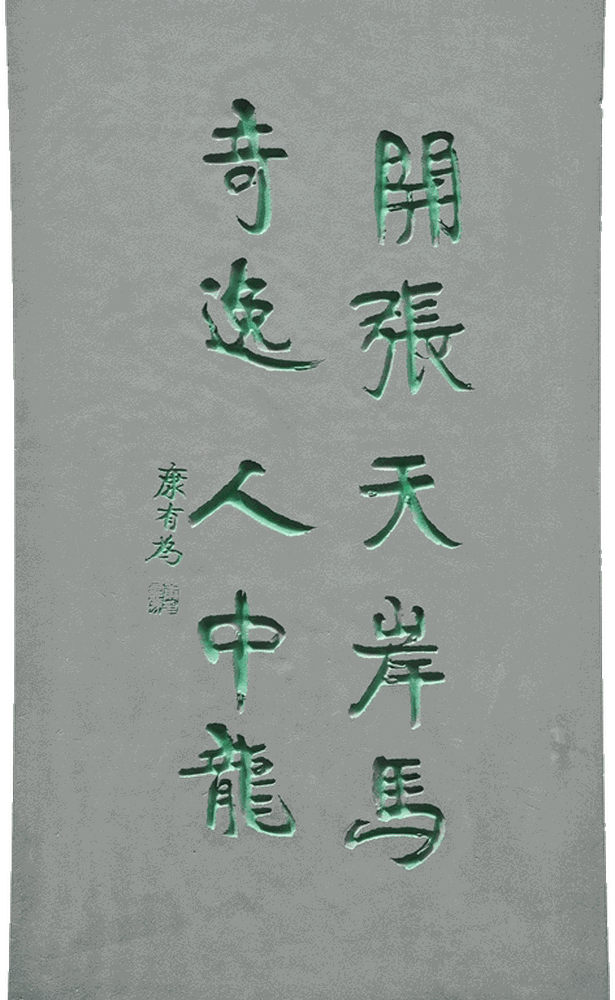
Kang Youwei: Xing Shu Couplet

Running script

Kang Youwei: Xing Shu Couplet

Kang You Wei was an ardent advocate of constitutional monarchy of the late Qing Dynasty. Apart from constitutional monarchy (which is to counterbalance absolute monarchy), the iconoclast took courage to propose a revamp in the troubled Chinese political system through the establishment of a parliamentary house, electorate and district councils. Kang was also a proponent of human rights, given the said political aspirations he had in mind. Unfortunately, his 100-day Reform Movement was thwarted by Empress Tzu His (Empress Dowager Ci Xi) who favoured the absolute monarchy. The failed movement forced him and another notable scholar who shared his thoughts, Liang Qi Chao, to flee China for Japan. He returned to China in 1913 after the 1911 Xinhai Revolution (the Chinese Revolution). Apart from his political aspirations, Kang was one of the major contributors to the development and promotion of the art of calligraphy in Chinese history. He authored a book called ‘Guang Yi Zhou Shuang Ji’ that is historically significant to the promotion of calligraphy. The book pays tribute to the blossoming of the art of calligraphy and epigraphy during the rule of Han and Wei dynasties. It gives prominence to the evolution of calligraphy and epigraphy over different epochs and plays an influential role in the study of this ancient art. In other words, the book sums up all the essences of the beauty of calligraphy and epigraphy in combination. The ‘Kang Nan Hai Ti’ produced in the later part of his life, which was inspired by Wei Dynasty’s ‘Xing Shu’ style, offers a close perspective into his individualized calligraphy style. Expect to see ‘weighty’, ‘substantial’ and ‘imposing’ calligraphy characteristics in this work. Kang is known for blending ‘Zhuan’ and ‘Li’ calligraphy styles into his ‘Xing Shu’ masterpiece. He loved to incorporate a generous amount of ‘Zhuan’ highlights with hints of ‘Li’ attributes in his calligraphy. The strokes seem to be vigorous and well composed, hearty yet oozing beauty in simplicity, unpretentious yet aesthetically dynamic.

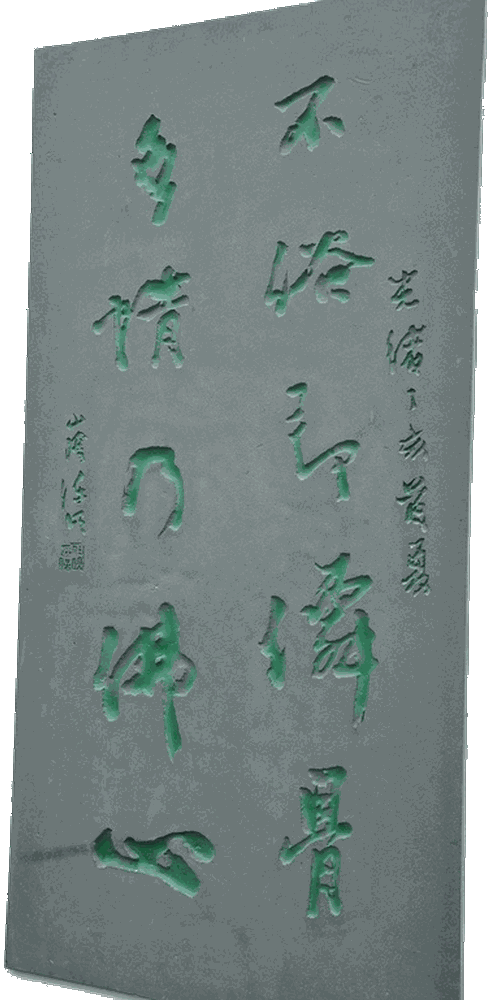
Ren Bonian: Running-Script Couplet

Running script

Ren Bonian: Running-Script Couplet

Ren Bonian was an outstanding modern painter and a leading figure in the Shanghai school. He absorbed techniques from folk painting as well as Western watercolor and sketching, strengthened the realist dimension of Chinese painting, and skillfully fused meticulous and freehand methods, traditional Chinese and Western approaches, literati painting and folk painting. His greatest achievements were in figure painting and bird-and-flower painting. Xu Beihong praised him as the foremost Chinese painter after Qiu Ying and even wrote an appraisal of his work. This couplet, ?If one is free from vulgarity, one has the bones of an immortal; if one is affectionate, one has the heart of a Buddha,? was written for the mountain gate of Nengren Temple on Baiyun Mountain in Guangzhou.

Yang Shoujing: Running-Script Couplet

Running script

Yang Shoujing: Running-Script Couplet

Yang Shoujing was a major late Qing and early Republican scholar of historical geography, epigraphy, bibliography, calligraphy, and book collecting. Together with leading scholars in philology and mathematics, he was counted among the ?three great excellences? of the Qing. His calligraphy had a deep influence extending even to Japan. In structure, brush use, and formal invention, his writing is full of fresh ideas: center-tip strokes, clearly articulated lifting and pressing, flexible variety, grace without slipperiness, and beauty without superficiality. The slanting upper-right horizontals and sweeping lower-left lines give his work a distinctive tension and an unforced strength.

Zhao Zhiqian: Excerpts from Shi You's ?Rapid Memorization Chapter?

Running script

Zhao Zhiqian: Excerpts from Shi You's ?Rapid Memorization Chapter?

Zhao Zhiqian was an outstanding Qing painter, calligrapher, and seal carver. Drawing on Qin and Han bronze and stone inscriptions, he selected widely yet distilled their strengths into a style that became known as the ?Zhao school.? His calligraphic achievement was broad, and he was especially skilled at using Northern stele structures in running script, written with a soft brush that gives the work richness and charm. This excerpt from Shi You's ?Rapid Memorization Chapter? is one of his representative works, with calm yet lively brushwork, dignified and simple structure, and an energetic force that fully reveals the spirit of Northern Wei-style epigraphy.

Zuo Zongtang: Running-Script Couplet

Running script

Zuo Zongtang: Running-Script Couplet

Zuo Zongtang was one of the leading military and political figures of the late Qing. In 1875 he led his forces to recover Xinjiang, and in 1884 he directed military affairs in Fujian to resist French aggression, achievements that secured his place in history. Though famed as a general, he was also deeply accomplished in letters and calligraphy, honoring epigraphic models and excelling in seal, clerical, running, and cursive script. His strokes are forceful and bold, his style expansive and heroic, and many of his couplets circulated widely. This pillar couplet, written for the Ouyuan garden in Suzhou and quoting Du Fu, reveals a spirited ambition through its lean brushwork, cool structure, and open layout.

Logo

Malaysia Chinese Calligraphy Stone Gallery

马来西亚
中华人文碑林

Find your peace within the words, and take its echo with you.

Copyright © 2025 中华人文碑林. All Rights Reserved.