Logo

Malaysia Chinese Calligraphy Stone Gallery

马来西亚
中华人文碑林

Home
About
ForewordCommitteeDiscover BeilinEvolution of Chinese CharactersCalligraphy AppreciationVisitor Feedback
GalleryDynastyEvents & DownloadsContact UsReservation
English
简体中文
English
繁體中文
日本語
Bahasa

Curated Collection

Curated Stillness

Let these collections be more than a display—let them be a wandering, a quiet gaze. Here, every stroke is a whisper of time, leading you into the boundless river of the written word.
Oracle Bone Script
Wei Stele Script
Regular Script with Semi-Cursive
Semi-Cursive Script
Li Shu, Kai Shu
Regular and cursive scripts
Cursive Script
Running script
Regular script
Big seal script
Xiaozhuan
Clerical script
Bronze Inscription
Shen Mu Yu: Kai Shu Hall Scroll

Regular script

Shen Mu Yu: Kai Shu Hall Scroll

Shen Mu Yu was a renowned defender of Chinese education in Malaysia. He served as chairman of Dong Zong, adviser to the Malaysia Calligraphy Association and the Malaysian International Modern Calligraphy and Painting Alliance, and president of the Malacca Confucian Association. He was also the first overseas Chinese recipient of Taiwan?s Administrative Cultural Award. He served as principal of several schools in Malacca, including Malacca Public First Primary School, Pay Teck Primary School, Pay Fong Primary School No. 1, Ping Min Primary School, and Chen Zhong Night School, and was listed in the Malaysia Book of Records as the country?s longest-serving principal. The Cheng Ho Cultural Museum in Malacca established the Shen Mu Yu Calligraphy Gallery in 2007, and the Shen Mu Yu Calligraphy and Cultural Relics Museum opened in Malacca in 2011. His style takes Yan as its structural bone and Zhao and Liu as its outward form, dignified, majestic, and powerful. His structures are compact and dense, his lines thick and full, and his brushwork steady and forceful. His distinctive style is known as the Shen style.

Chen Jia Geng: Kai Shu Couplet

Regular script

Chen Jia Geng: Kai Shu Couplet

Chen Jia Geng’s roots belong to the ancestral hometown of Ji Mei She, Tong An District, Fu Jian Province. He was a dedicated and notable educationist, typical neo-Confucian businessman, chairman of multiple fund-raising associations for overseas Chinese in Southeast Asia, leader for overseas Chinese in Southeast Asia, the founder of Nanyang Siang Pau, Jimei University and Xiamen University. Chen was venerated as the ‘Hero of Overseas Chinese’ for his pivotal role in taking care of the welfare of his fellow countrymen. Famous tycoon and philanthropist Tan Sri Dato' Dr. Lee Kong Chian was his son-in-law. Chen authored two notable books - ‘The Memoirs of Overseas Chinese’ in 1946 and ‘The Thoughts of Overseas Chinese’ in 1949. His calligraphy is pleasantly smooth and natural, bearing the ‘Ma Gu Xian Tan’ style as authored by Yan Zhen Qing.

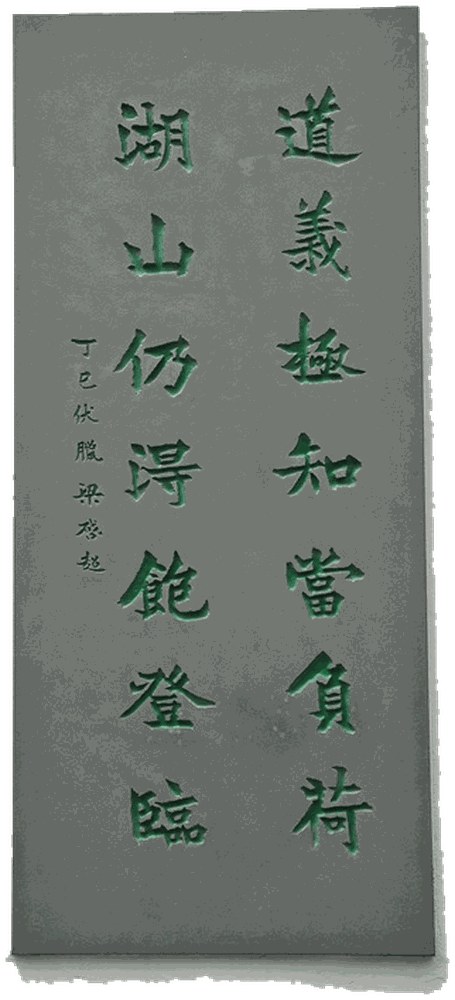
Liang Qichao: Kai Shu Couplet

Regular script

Liang Qichao: Kai Shu Couplet

Liang Qi Chao was a student of Kang You Wei. Together with Kang, Liang took part in the 100-day Reform Movement against the absolute monarchy. The uprising movement was frustrated by the imperial forces and they had to flee to Japan. A few years prior to the 100-day Reform Movement, Liang had already teamed up with Xia Zeng You and Tan Si Tong for the Poetry Revolution, calling for contemporary poetry pieces that reflect the present affairs. This was followed by the Literature Revolution to propagate their political thoughts. Altogether, Liang was a notable political activist, socio-economic reformer, educationist, historian and litterateur in the modern history of China. He was an admirer of the Northern Dynasties’ calligraphy and was particularly fond of the ‘Zhang Hei Nü Mu Zhi’ poetry piece. His brush-strokes were generally ‘Li Shu’ driven, well-knit and dexterous, expressed in a subtle yet effective way, tightly-stroked from the core and well poised.

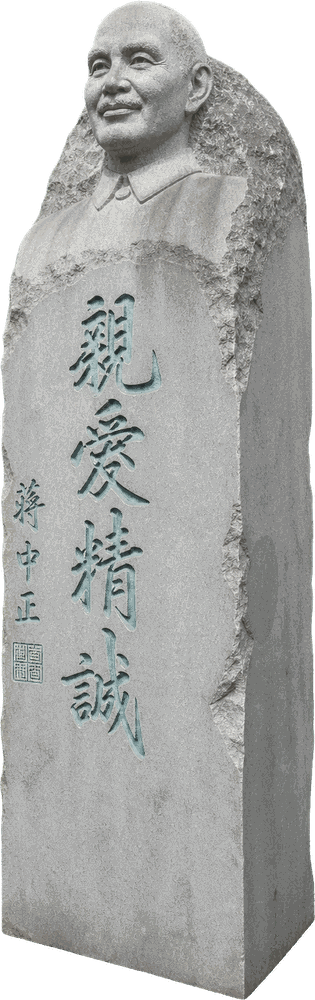
Jiang Zhongzheng: Qin Ai Jing Cheng

Regular script

Jiang Zhongzheng: Qin Ai Jing Cheng

Jiang Zhong Zheng, also known as Jiang Jie Shi or Jiang Kai-shek, was a notable leader who took charge of the party, politics and military ruled by Kuomintang. He joined the Tong Men Hui (Chinese Alliance for Democracy) in 1908 while studying in Japan and there was no looking back ever since. Upon returning to his homeland in 1924, he was appointed the Commandant of Huang Pu Military Academy. He later became the Chief Commander of the National Revolution Army. He was appointed the the President of the Republic of China in 1948 as mandated by the National Assembly of the Republic of China.  He later announced his sensational step-down on 21 January 1949. The loss to the Chinese Communist Party (CCP) in a civil war the same year forced him to retreat to Taiwan, where he assumed the role of the President of Taiwan and Director-General of Kuomintang. The ‘Qing Ai Jing Cheng’ motto penned by Jiang carries the earnest of a military commander and politician, spiritually unruffled and serious-mindedness. His calligraphy bears some resemblance to Tang Dynasty’s, stately and resolute.

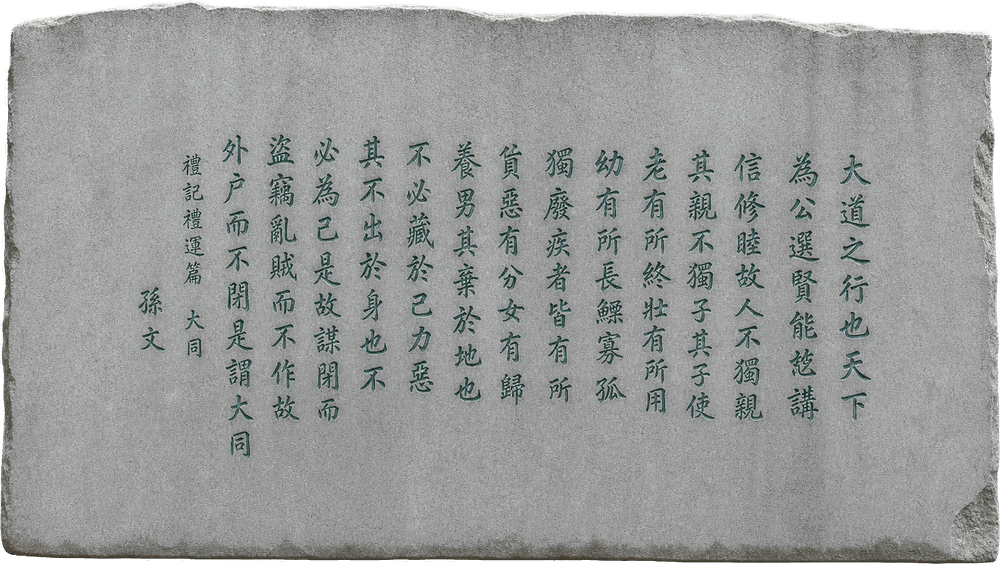
Sun Zhongshan: Liyun Datong Pian

Regular script

Sun Zhongshan: Liyun Datong Pian

Sun Zhong Shan was the Founding Father of the Republic of China cherished by people of both sides of the straits. The Father of the 1911 Chinese Revolution was also the Founder of Kuomintang (Chinese Nationalist Party) who championed ‘The Three Principles of the People’ (nationalism, democracy and the people’s livelihood). Sun was a strong advocate against feudalism. One of his main political ideals was to establish a republic by overthrowing the absolute monarchy system. He set up Zhong Guo Tong Men Hui (literally means the Chinese Alliance for Democracy) in 1905, paving the way for the game-changing 1911 Chinese Revolution. Upon the successful 1911 Chinese Revolution (a.k.a Xin Hai Revolution), Sun became the first interim President of the Republic of China. In 1940, he was officially immortalized as the ‘Father of the Republic of China’. Sun was not initially known for his calligraphy finesse. However, given his calligraphy works that bear the characteristics synonymous with Yan Zhen Qing, Su Dong Po and ancient Northern Dynasties’, his calligraphy artistry started to gain attention among scholars. His calligraphy bears a rather relaxing style, but it exudes a spirit of broad-heartedness, vigour and grandeur, befitting a scholarly cultured personality.

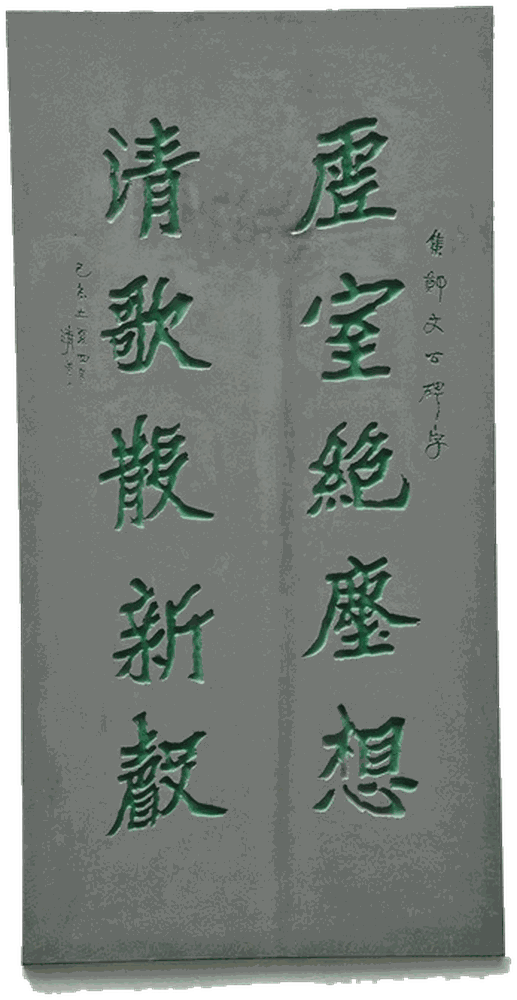
Li Ruiqing: Kai Shu Couplet

Regular script

Li Ruiqing: Kai Shu Couplet

Li Rui Qing was a famous calligrapher of late Qing Dynasty and early Republic. He was the Education Administrator of Ning Ti in She Jiang, Jiang Su and the Supervisor of Liang Jiang’s Teachers College. A lifetime advocate of Art Education, Li retreated to Shanghai after the 1911 Xinhai Revolution, living a normal life with a concealed identity of ‘Qing Dao Ren’. Li’s calligraphy was influenced by the schools of thought belonging to Zhou, Qin, Han and Wei dynasties. He was versatile calligrapher renowned for the ‘Zhuan’ and ‘Li’ styles of calligraphy. His calligraphy appears to be ‘self-assured’ and ‘invigorating’. His Zhuan-style painting plays a vital role in fostering a proud scholarly driven tradition for many generations to come.

Lin Zexu: Stele of the Ten Futile Things

Regular script

Lin Zexu: Stele of the Ten Futile Things

Lin Zexu was not only a far-sighted statesman but also a skilled calligrapher. Grounded in the calligraphy of Ouyang Xun, his writing does not seek charm through slanting strokes; instead it is dignified, calm, and orderly, with subtle variation inside its regularity and a natural ease in the places where intention is most visible. Although this piece is less marked by the deep hidden strength and archaic simplicity often associated with Lin Zexu, its text still carries a strong moral and educational force.

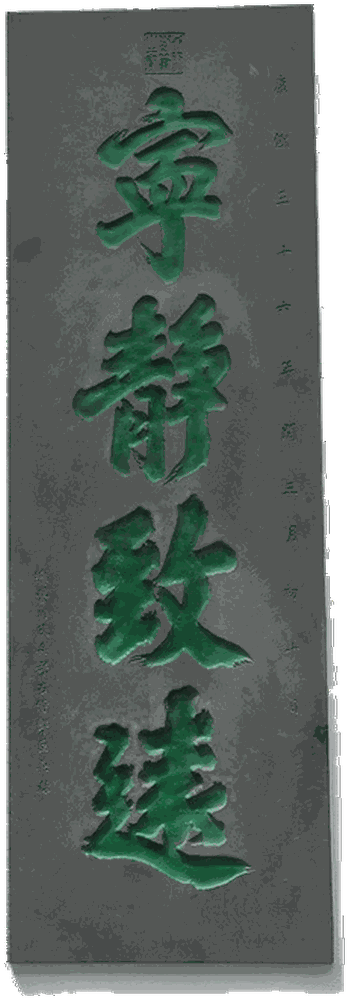
Emperor Kangxi: Tranquility Leads to Great Vision

Regular script

Emperor Kangxi: Tranquility Leads to Great Vision

The ?Tranquility Leads to Great Vision? stele preserves four large regular-script characters written by the Kangxi Emperor in 1679 for Wu He, then Governor-General of Shaanxi and Sichuan. The composition is rigorous and dignified, the brushwork full and rounded, and the overall effect steady yet luminous. Very little of Kangxi's surviving ink writing remains, so this piece is considered especially precious.

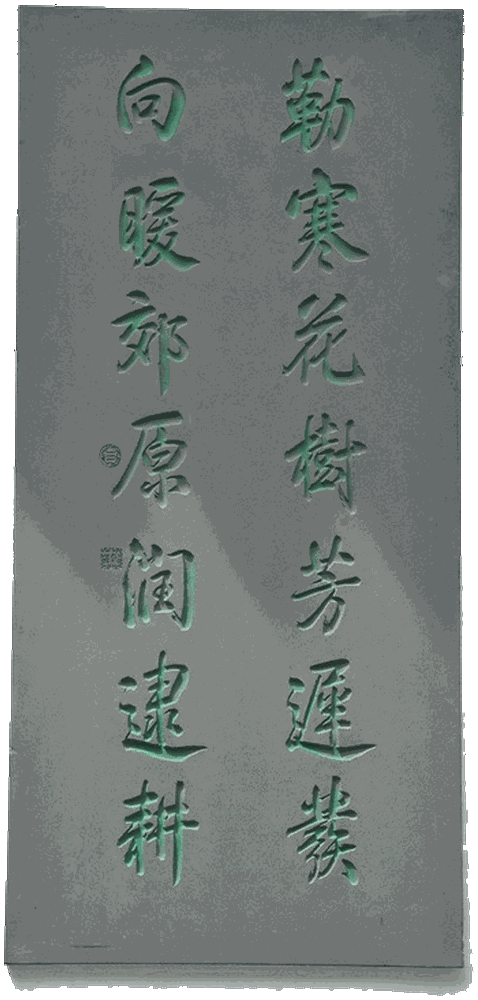
Emperor Qianlong: Imperial Couplet at Daxinzhuang

Regular script

Emperor Qianlong: Imperial Couplet at Daxinzhuang

This couplet, ?Cold weather delays the flowering trees; warmth moistens the fields for ploughing,? was written by the Qianlong Emperor for the Sui'an Room at the Daxinzhuang traveling palace in Sanhe. Qianlong visited the Yanjiao palace area many times and left behind numerous poems and couplets there. This inscription expresses the idea that cold weather hinders the growth of flowers and trees, while a warm climate benefits agricultural development.

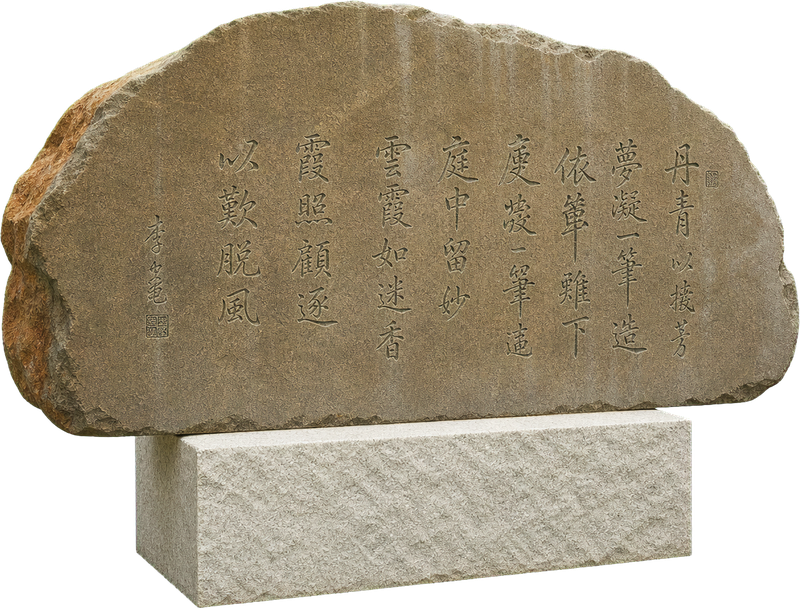
Emperor Huizong of Song: Nongfang Poem

Regular script

Emperor Huizong of Song: Nongfang Poem

Nongfang Poem is a five-character regulated poem written by Emperor Huizong of Song in his Slender Gold style. Now held in the National Palace Museum in Taipei, it is a large-character work on silk in twenty lines, with two characters per line and forty characters in total. The style is highly distinctive: fine and resilient like silver hooks and iron strokes, yet with a sense of fullness within its lean strength. A colophon by Chen Bangyan appears after the scroll. Emperor Huizong possessed exceptional artistic talent and was deeply accomplished in poetry, painting, calligraphy, music, and theatre. His calligraphy drew from Huang Tingjian of the Song and Xue Ji of the Tang, developing into the sharp, elegant style known as Slender Gold. Its structure is tightly gathered at the center and opened outward, with balanced forms, light pressing and firm finishing strokes, crisp pauses and turns, and an airy, refined quality that reveals the unique character of Slender Gold script.

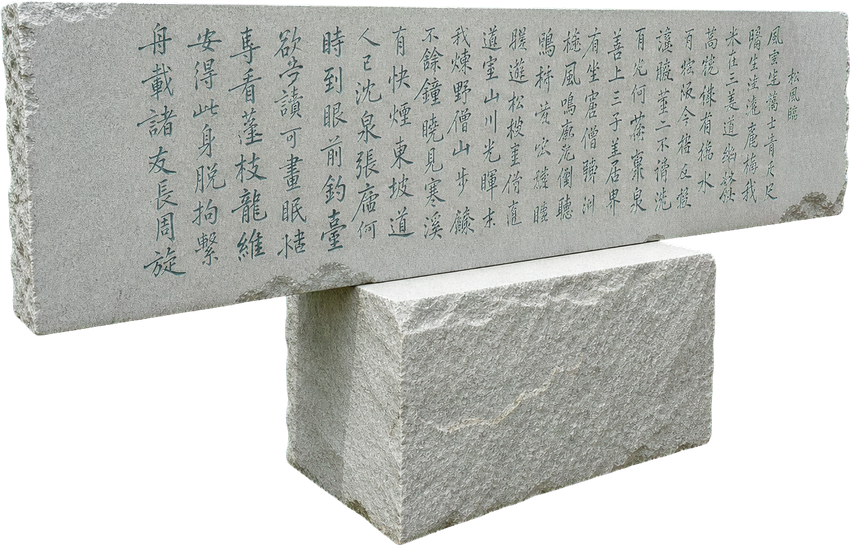
Huang Tingjian: Songfeng Pavilion

Regular script

Huang Tingjian: Songfeng Pavilion

Songfeng Pavilion is associated with Huang Tingjian, one of the Four Great Masters of Song calligraphy. Huang?s calligraphy is known for its elongated structure, forceful turns, and distinctive rhythm. The characters in this work stretch and gather with strong internal energy, creating a sense of height, movement, and tension. Its brushwork is elegant yet powerful, showing Huang Tingjian?s highly personal approach to structure and line.

Su Shi: Remembering Red Cliff

Regular script

Su Shi: Remembering Red Cliff

Remembering Red Cliff is based on Su Shi?s famous ci poem, one of the best-known literary works of the Northern Song. The stele combines poetry, calligraphy, and carved stone into a single visual tribute to Su Shi?s artistic world. Its brushwork is steady and dignified, with a strong sense of rhythm and weight. The composition reflects the grandeur of the poem, evoking history, landscape, and the emotional depth of Su Shi?s writing.

Logo

Malaysia Chinese Calligraphy Stone Gallery

马来西亚
中华人文碑林

Find your peace within the words, and take its echo with you.

Copyright © 2025 中华人文碑林. All Rights Reserved.