Malaysia Chinese Calligraphy Stone Gallery
Curated Collection
让典藏不只是一种展示,也成为一种漫游与凝视。在这里,每一道刻痕都是时间的低语,带您走入汉字演变的浩瀚长河。
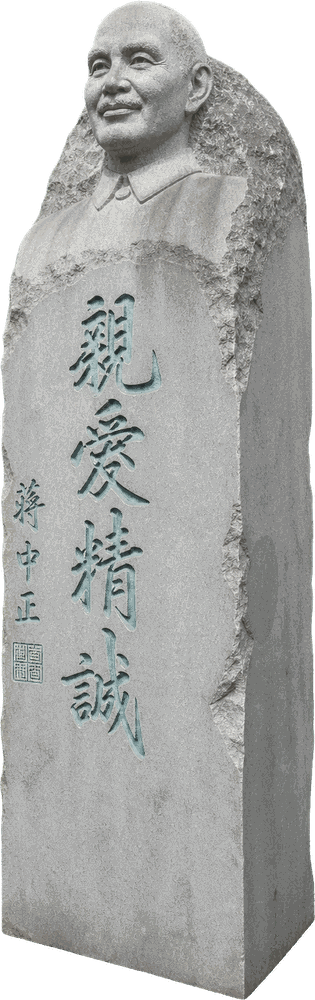
Jiang Zhongzheng
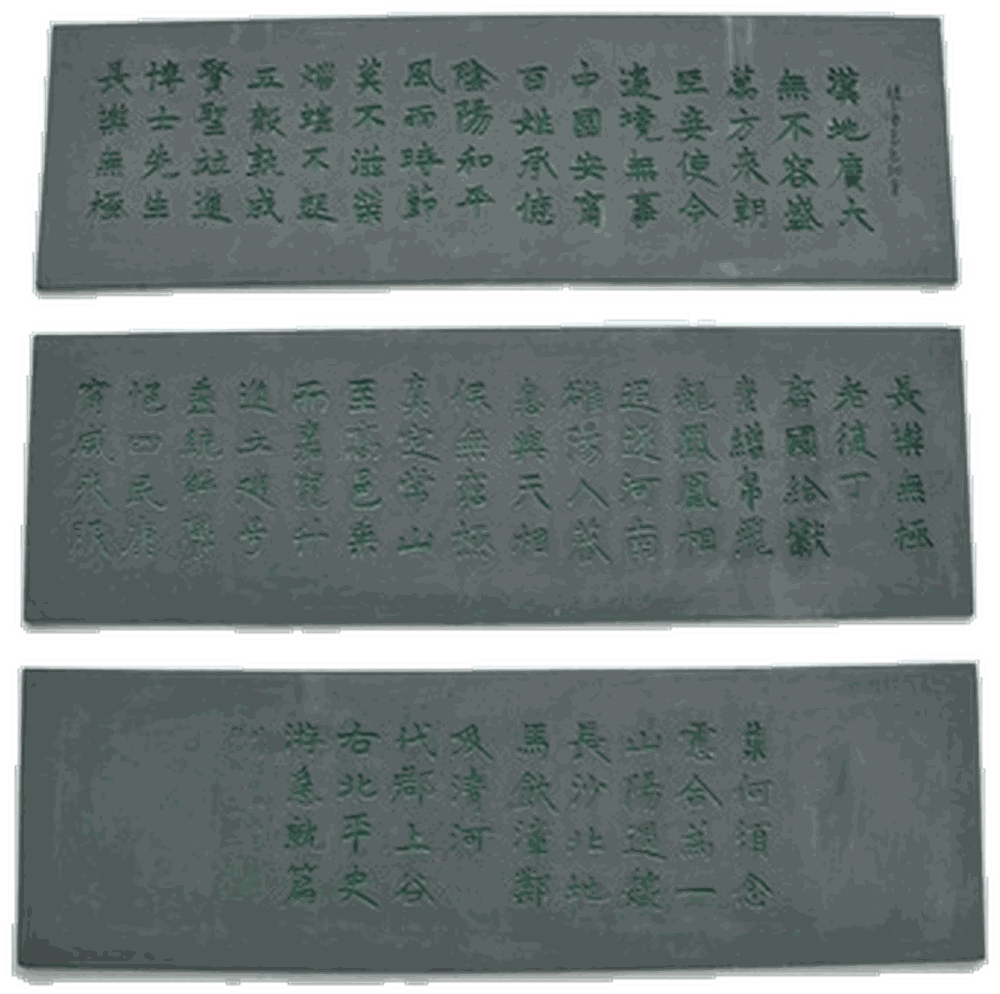
Jiang Zhong Zheng, also known as Jiang Jie Shi or Jiang Kai-shek, was a notable leader who took charge of the party, politics and military ruled by Kuomintang. He joined the Tong Men Hui (Chinese Alliance for Democracy) in 1908 while studying in Japan and there was no looking back ever since. Upon returning to his homeland in 1924, he was appointed the Commandant of Huang Pu Military Academy. He later became the Chief Commander of the National Revolution Army. He was appointed the the President of the Republic of China in 1948 as mandated by the National Assembly of the Republic of China. He later announced his sensational step-down on 21 January 1949. The loss to the Chinese Communist Party (CCP) in a civil war the same year forced him to retreat to Taiwan, where he assumed the role of the President of Taiwan and Director-General of Kuomintang. The ‘Qing Ai Jing Cheng’ motto penned by Jiang carries the earnest of a military commander and politician, spiritually unruffled and serious-mindedness. His calligraphy bears some resemblance to Tang Dynasty’s, stately and resolute.
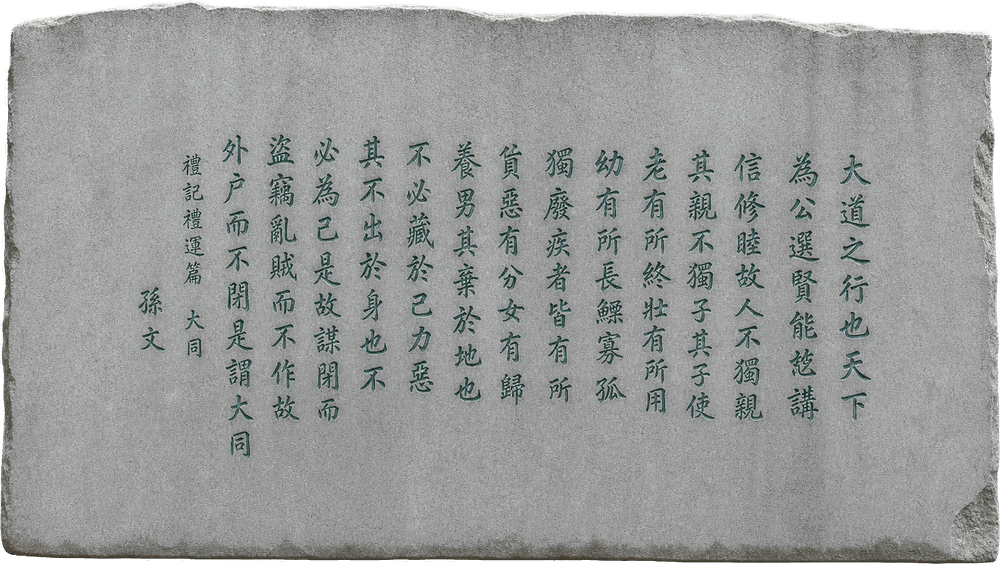
Sun Zhongshan
Sun Zhong Shan was the Founding Father of the Republic of China cherished by people of both sides of the straits. The Father of the 1911 Chinese Revolution was also the Founder of Kuomintang (Chinese Nationalist Party) who championed ‘The Three Principles of the People’ (nationalism, democracy and the people’s livelihood). Sun was a strong advocate against feudalism. One of his main political ideals was to establish a republic by overthrowing the absolute monarchy system. He set up Zhong Guo Tong Men Hui (literally means the Chinese Alliance for Democracy) in 1905, paving the way for the game-changing 1911 Chinese Revolution. Upon the successful 1911 Chinese Revolution (a.k.a Xin Hai Revolution), Sun became the first interim President of the Republic of China. In 1940, he was officially immortalized as the ‘Father of the Republic of China’. Sun was not initially known for his calligraphy finesse. However, given his calligraphy works that bear the characteristics synonymous with Yan Zhen Qing, Su Dong Po and ancient Northern Dynasties’, his calligraphy artistry started to gain attention among scholars. His calligraphy bears a rather relaxing style, but it exudes a spirit of broad-heartedness, vigour and grandeur, befitting a scholarly cultured personality.
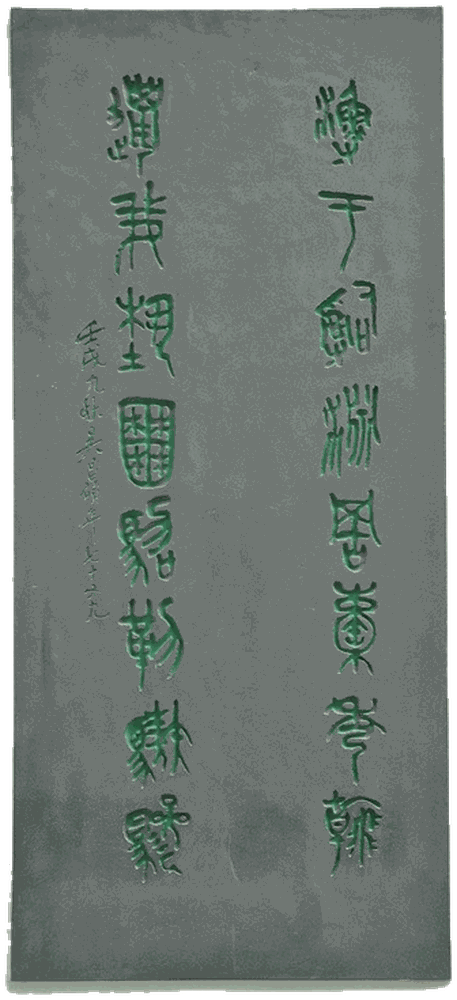
Wu Changshuo
Wu Chang Shuo was a famous painter, calligrapher and seal engraving expert (or seal artist) of the late Qing Dynasty. He was an icon of Shanghai’s creative arena, being the inaugural principal of the Xiling Society of Seal Arts in Hangzhou. His derived his calligraphy aspirations from Yan Zhen Qing initially, followed by Zhong Yuan Chang. For calligraphy stone engraving, he preferred the ‘Li Shu’ school of thought of the ancient Han Dynasty. His ‘Zhuan Shu’ calligraphy was inspired by the script engraving on the stones of the ancient Qin Dynasty. Wu’s ‘Xing Shu’ calligraphy manifests the tilting strokes of Huang Ting Jian and Wang Duo’s. It oozes the art of composition of Huang Dao Zhou’s. Wu’s calligraphy also took in the essence of ‘Zhuan’ and ‘Zhou’ scripts of the Northern Dynasties. His stroke-work could be dramatic, bold and unrestrained, yet flamboyant at times. In his later life, Wu pushed his calligraphy mastery to the next level, breaking the boundaries of the ancient stone-based script engraving. He injected the ‘expressionist’ elements into his ‘Zhuan’ calligraphy works to amplify the artistic transformation by using added inking concentration and getting motivated by the art of stone engraving. His new perspective on ‘Zhuan Shu’ creation helped redefine and add a new value to the aesthetic aspect of calligraphy. The former principal of the Xiling Society of Seal Arts bolstered up his influential role in the creative arena with his ingenuity in fusing calligraphy, painting and stone engraving into a creative masterpiece.
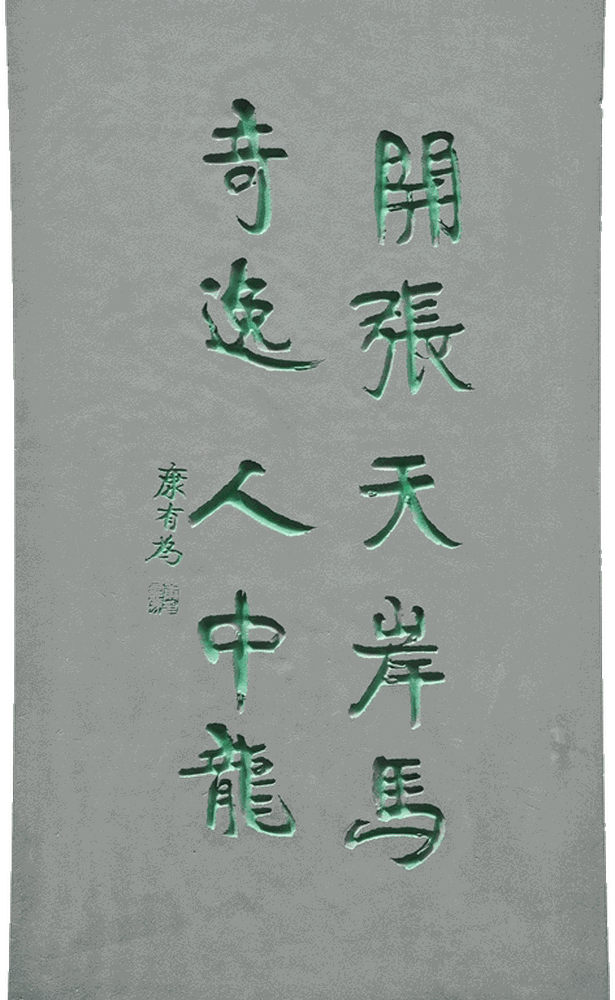
Kang Youwei
Kang You Wei was an ardent advocate of constitutional monarchy of the late Qing Dynasty. Apart from constitutional monarchy (which is to counterbalance absolute monarchy), the iconoclast took courage to propose a revamp in the troubled Chinese political system through the establishment of a parliamentary house, electorate and district councils. Kang was also a proponent of human rights, given the said political aspirations he had in mind. Unfortunately, his 100-day Reform Movement was thwarted by Empress Tzu His (Empress Dowager Ci Xi) who favoured the absolute monarchy. The failed movement forced him and another notable scholar who shared his thoughts, Liang Qi Chao, to flee China for Japan. He returned to China in 1913 after the 1911 Xinhai Revolution (the Chinese Revolution). Apart from his political aspirations, Kang was one of the major contributors to the development and promotion of the art of calligraphy in Chinese history. He authored a book called ‘Guang Yi Zhou Shuang Ji’ that is historically significant to the promotion of calligraphy. The book pays tribute to the blossoming of the art of calligraphy and epigraphy during the rule of Han and Wei dynasties. It gives prominence to the evolution of calligraphy and epigraphy over different epochs and plays an influential role in the study of this ancient art. In other words, the book sums up all the essences of the beauty of calligraphy and epigraphy in combination. The ‘Kang Nan Hai Ti’ produced in the later part of his life, which was inspired by Wei Dynasty’s ‘Xing Shu’ style, offers a close perspective into his individualized calligraphy style. Expect to see ‘weighty’, ‘substantial’ and ‘imposing’ calligraphy characteristics in this work. Kang is known for blending ‘Zhuan’ and ‘Li’ calligraphy styles into his ‘Xing Shu’ masterpiece. He loved to incorporate a generous amount of ‘Zhuan’ highlights with hints of ‘Li’ attributes in his calligraphy. The strokes seem to be vigorous and well composed, hearty yet oozing beauty in simplicity, unpretentious yet aesthetically dynamic.
Zeng Xi
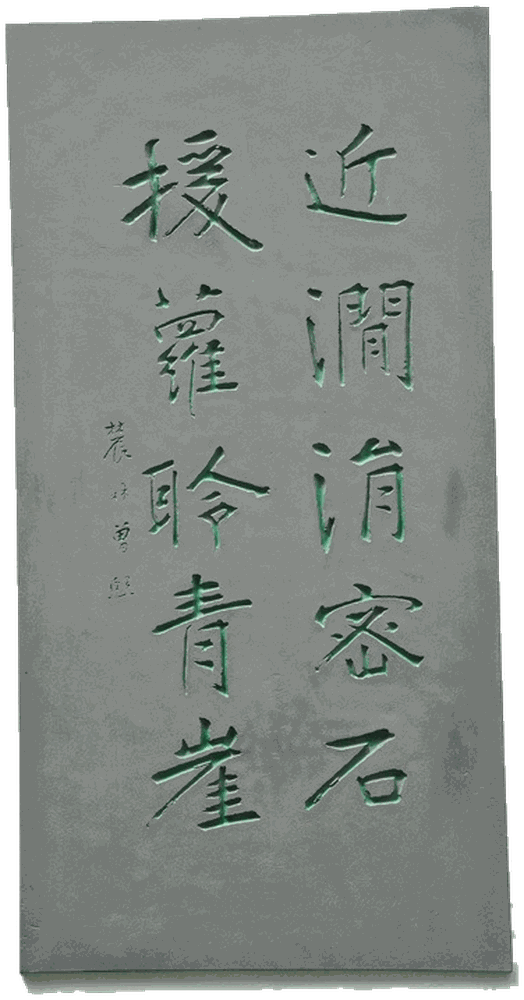
Zeng Xi was a multi-talented figure in poetry, calligraphy and painting. Inspired by Zhong Yao and Wang Xi Zhi’s calligraphy, Zeng also soaked up the essence of ‘Xia Chen Bei’ (an ancient stone inscription) and ‘Zhang Hei Rǚ’ (a tablet inscription) to perfect his calligraphy. His calligraphy demonstrates a mixture of conformities and nonconformities. Zeng loved to keep the composition and alignment of his calligraphy ‘spacious’, with slightly ‘extended’ strokes. His calligraphy style is very much epigraphy driven. He took on painting seriously in his later life and became an advocate of calligraphy-imbued paintings ever since, thus earning him an illustrious reputation across the calligraphy and painting fraternity. Zeng Xi and Li Rui Qing are historically known as the ‘Nan Zeng Bei Li’ combination (literally means Zeng ruled the South while Li had the North at their feet through their calligraphy and painting prowess). Along with Li Rui Qing, Shen Zeng Zhi, Wu Chang Shuo, they formed the ‘Four Greatest Calligraphers of the Early Republic Era’. The legendary Zhang Da Qian was one of the disciples of Zeng Xi.
Huang Binhong
Huang Bin Hong was a pioneer in Chinese modern art. The art fraternity labelled him ‘the virtuoso of Chinese ink-wash painting’. Apart from landscape paintings, Huang’s paintings of flowers and birds were equally legendary. He thrived on his theory of marrying calligraphy and painting for added distinction. The prolific art contributor was resolute in promoting the clever use of ink and brush whenever possible. This is because both disciplines, calligraphy and painting, require a great amount of skills to produce a masterpiece.
Li Ruiqing
Li Rui Qing was a famous calligrapher of late Qing Dynasty and early Republic. He was the Education Administrator of Ning Ti in She Jiang, Jiang Su and the Supervisor of Liang Jiang’s Teachers College. A lifetime advocate of Art Education, Li retreated to Shanghai after the 1911 Xinhai Revolution, living a normal life with a concealed identity of ‘Qing Dao Ren’. Li’s calligraphy was influenced by the schools of thought belonging to Zhou, Qin, Han and Wei dynasties. He was versatile calligrapher renowned for the ‘Zhuan’ and ‘Li’ styles of calligraphy. His calligraphy appears to be ‘self-assured’ and ‘invigorating’. His Zhuan-style painting plays a vital role in fostering a proud scholarly driven tradition for many generations to come.
Ren Bonian
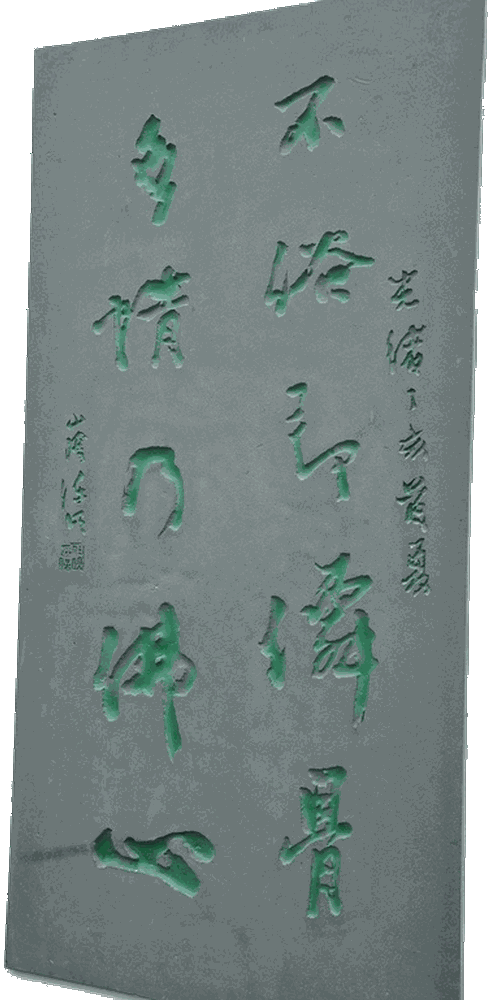
Ren Bonian was an outstanding modern painter and a leading figure in the Shanghai school. He absorbed techniques from folk painting as well as Western watercolor and sketching, strengthened the realist dimension of Chinese painting, and skillfully fused meticulous and freehand methods, traditional Chinese and Western approaches, literati painting and folk painting. His greatest achievements were in figure painting and bird-and-flower painting. Xu Beihong praised him as the foremost Chinese painter after Qiu Ying and even wrote an appraisal of his work. This couplet, ?If one is free from vulgarity, one has the bones of an immortal; if one is affectionate, one has the heart of a Buddha,? was written for the mountain gate of Nengren Temple on Baiyun Mountain in Guangzhou.
Yang Shoujing
Yang Shoujing was a major late Qing and early Republican scholar of historical geography, epigraphy, bibliography, calligraphy, and book collecting. Together with leading scholars in philology and mathematics, he was counted among the ?three great excellences? of the Qing. His calligraphy had a deep influence extending even to Japan. In structure, brush use, and formal invention, his writing is full of fresh ideas: center-tip strokes, clearly articulated lifting and pressing, flexible variety, grace without slipperiness, and beauty without superficiality. The slanting upper-right horizontals and sweeping lower-left lines give his work a distinctive tension and an unforced strength.
Zhao Zhiqian
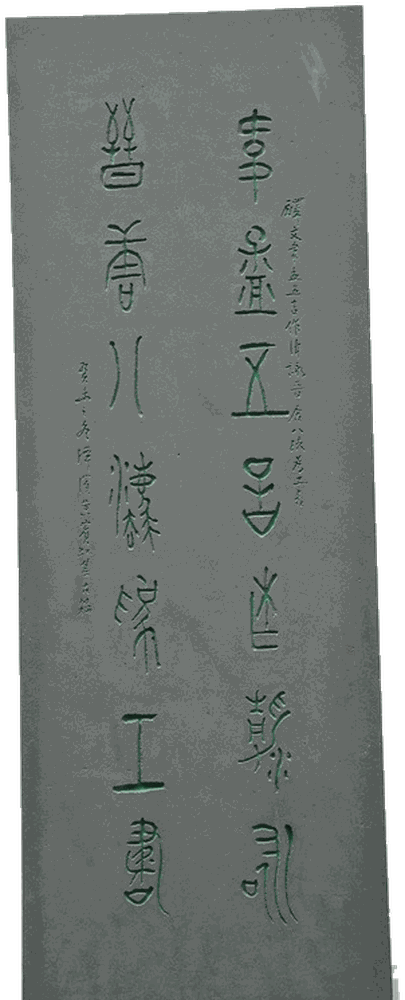
Zhao Zhiqian was an outstanding Qing painter, calligrapher, and seal carver. Drawing on Qin and Han bronze and stone inscriptions, he selected widely yet distilled their strengths into a style that became known as the ?Zhao school.? His calligraphic achievement was broad, and he was especially skilled at using Northern stele structures in running script, written with a soft brush that gives the work richness and charm. This excerpt from Shi You's ?Rapid Memorization Chapter? is one of his representative works, with calm yet lively brushwork, dignified and simple structure, and an energetic force that fully reveals the spirit of Northern Wei-style epigraphy.
Zuo Zongtang
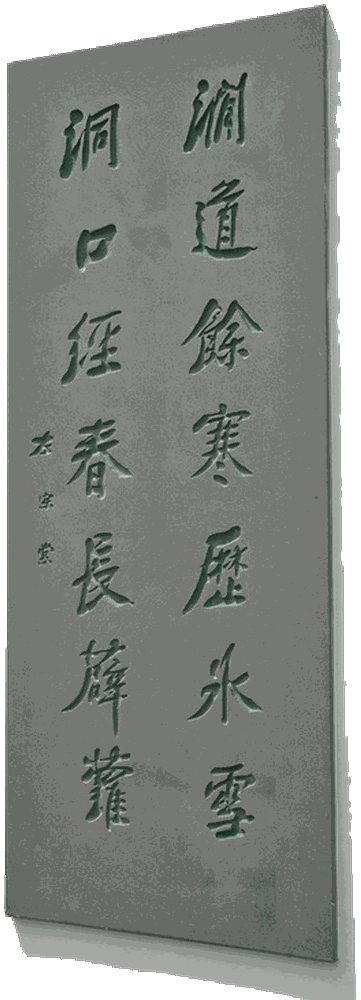
Zuo Zongtang was one of the leading military and political figures of the late Qing. In 1875 he led his forces to recover Xinjiang, and in 1884 he directed military affairs in Fujian to resist French aggression, achievements that secured his place in history. Though famed as a general, he was also deeply accomplished in letters and calligraphy, honoring epigraphic models and excelling in seal, clerical, running, and cursive script. His strokes are forceful and bold, his style expansive and heroic, and many of his couplets circulated widely. This pillar couplet, written for the Ouyuan garden in Suzhou and quoting Du Fu, reveals a spirited ambition through its lean brushwork, cool structure, and open layout.
He Shaoji
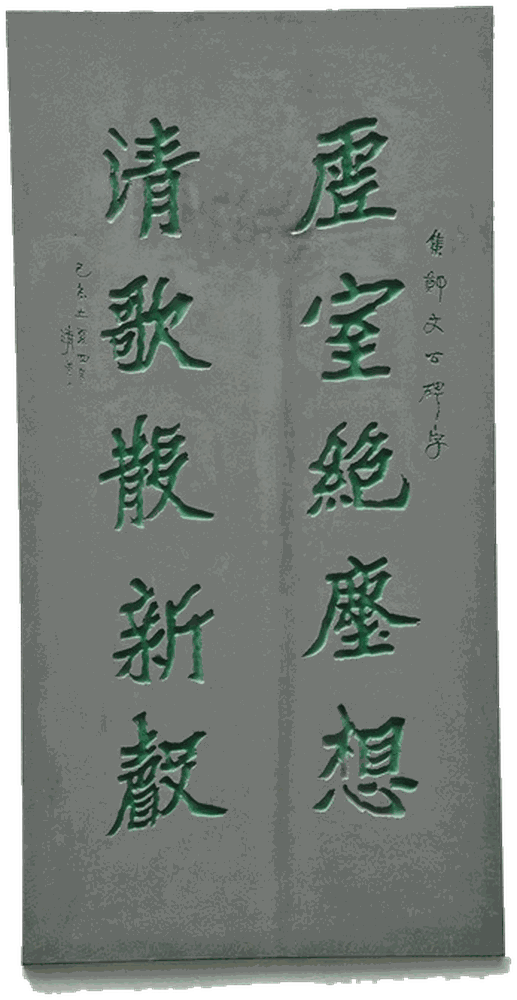
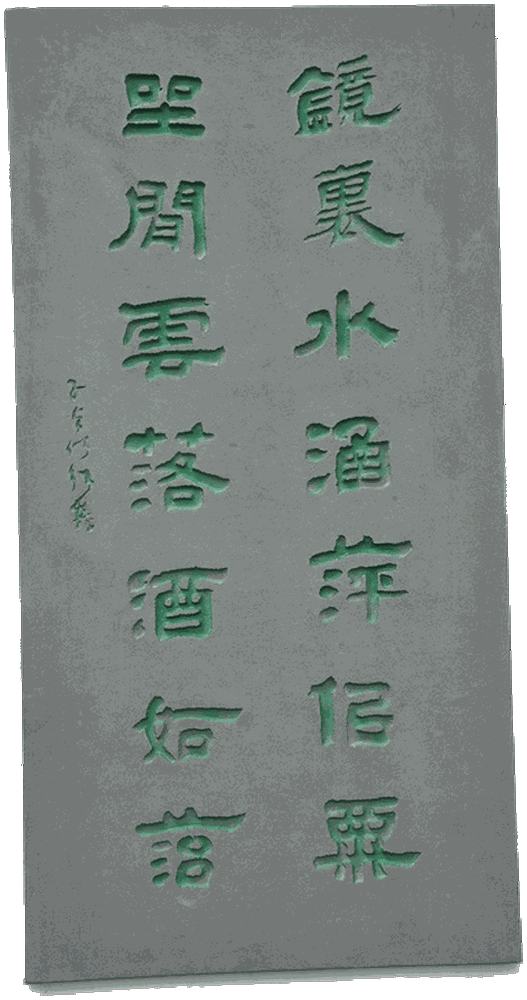
He Shaoji was one of the most influential calligraphers of the late Qing. Early on he studied Yan Zhenqing, then turned to Northern Dynasty stone inscriptions, and only around the age of sixty began writing seal and clerical script extensively. His regular script borrows the expansive structure of Yan while avoiding looseness, and it also incorporates the dense, steep qualities of Northern Dynasties steles, Ouyang Xun, and Ouyang Tong, along with the spirit of works such as the ?Zhang He N? Epitaph? and the ?Daoyin Stele.? These combined influences make his calligraphy exceptional.