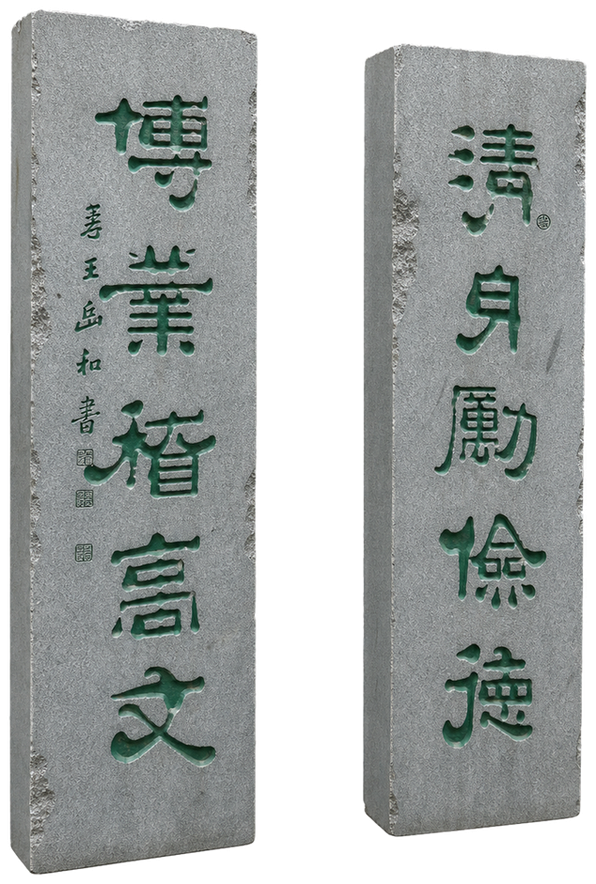
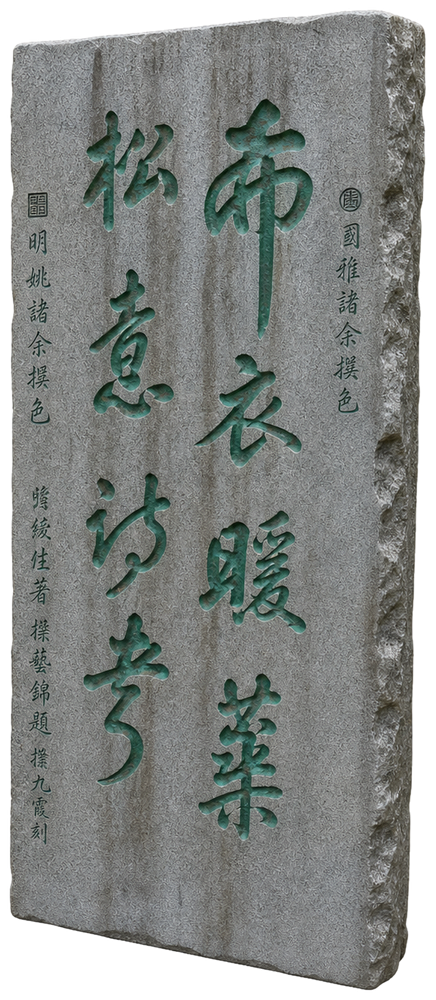
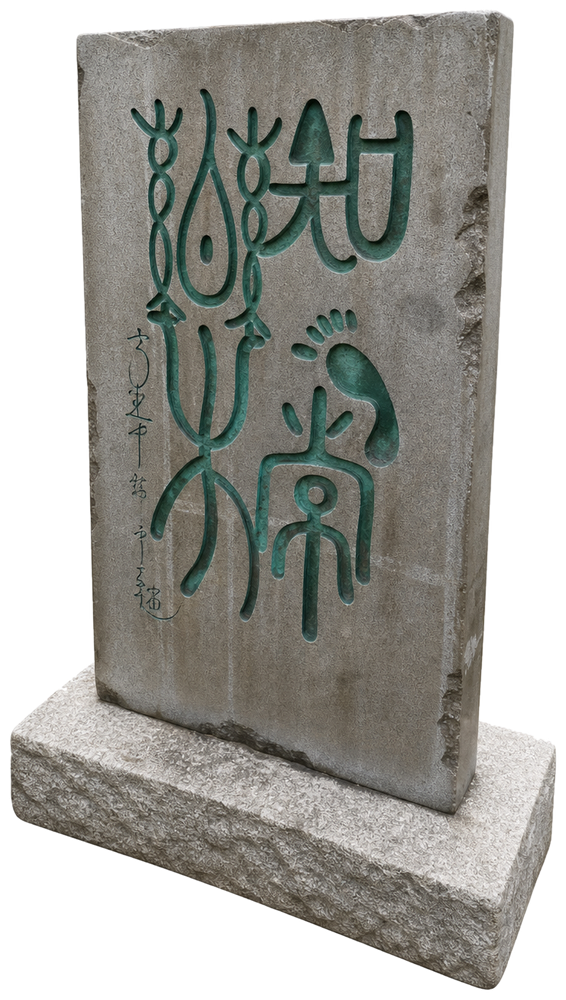
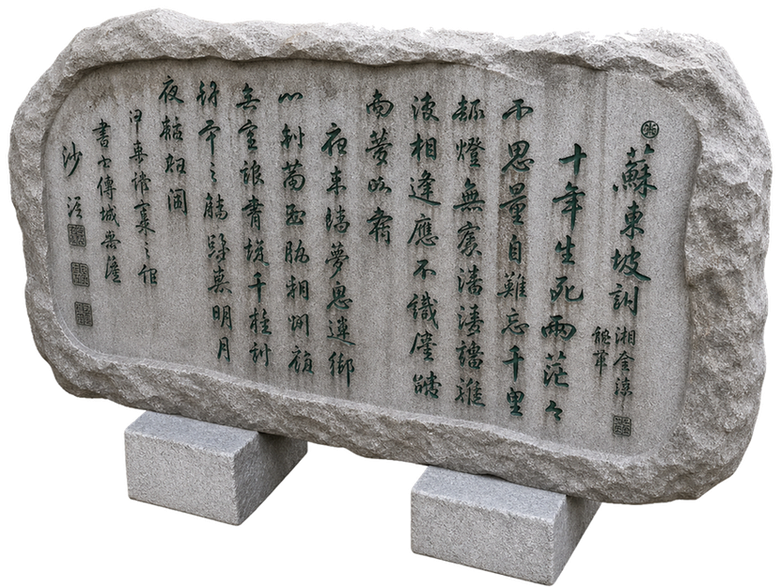
Malaysia Chinese Calligraphy Stone Gallery
Curated Collection
让典藏不只是一种展示,也成为一种漫游与凝视。在这里,每一道刻痕都是时间的低语,带您走入汉字演变的浩瀚长河。
Yang Jin Rong
Yang Jin Rong, ancestrally from Dapu, Guangdong, began studying calligraphy when young under Xu Yuehan, Huang Guobin, and Pan Shou, and made calligraphy teaching his profession. He was principal of Metropolitan Art Institute, adjunct lecturer at Southern University College, and curator of the Johor Bahru Calligraphy Gallery. He also served as adviser to the Chinese Humanistic Stele Forest, former deputy president and judging committee member of the Malaysia Calligraphy Association, president of the Johor Calligraphy Association, chairman of the Johor Bahru liaison committee of the Malaysia Calligraphy Association, adviser to the Miri Calligraphy Association in Sarawak, and adviser to the Johor Poetry Society. His early works, such as Lanxi Boat Song, were strongly experimental, exploring different structural line qualities and variations in ink density. His mature works, such as his final piece Drunken Sleep at the Orchid Pavilion, placed greater emphasis on the spatial aesthetics of empty space, fully reflecting his open-minded view of a freely expressed life.
Chen Guang Shi
Chen Guang Shi, originally from Yongchun, Fujian, worked in painting, calligraphy, and seal carving. He was a member of the Calligraphy Development Committee of the Malaysian Institute of Art and served as judge for national calligraphy competitions. He held dozens of solo exhibitions in Malaysia, Singapore, Bangkok, Indonesia, the Philippines, Vietnam, and Tahiti. His calligraphy emerges from the Tang style of Yan Zhenqing and also carries the charm of Pan Shou. This hall scroll was written in one breath; its composition is unified, the strokes are full, rounded, strong, elegant, and bony, expressing a quiet and refined mood.
Zheng Tian Bing
Zheng Tian Bing, originally from Yongchun, Fujian, used the sobriquet Zuimo and was one of the founders of the Malaysia Calligraphy Association. He served as principal of Pei Choon Primary School in Semerah, Hua Yu Primary School in Parit Jawa, and Chung Hwa First Primary School in Muar; chairman of the Johor branch of the Malaysian Chinese Cultural Association; member of Nanzhou Poetry Society; and president of Times Art Institute. In 2006, he received the Honorary Cultural Award from the Malaysian Chinese Cultural Association. He published Selected Calligraphy and Paintings of Zheng Tian Bing. In his early years he studied under Chen Renhao, beginning with the styles of Ouyang Xun and Liu Gongquan, and often used fountain pens and bamboo twigs as writing tools. His calligraphy frequently shapes characters through form, producing varied and lively effects.
Peng Shi Lin
Peng Shilin, originally from Changsha, Hunan, used the pen name Cuiyuan. He came south in 1950 and served as principal of Perak Girls? National-Type Secondary School in Ipoh for twenty-five years, later teaching calligraphy at the Kaying Association. He excelled in poetry and ci lyrics, served as president of the Ipoh Fufeng Poetry Society, and wrote the classical poetry collection Selected Poems from Jucui Garden and the prose collections Leisure Talk by the Night Window and Notes by the Study Window. He was one of the founders and advisers of the Malaysia Calligraphy Association. In his early years he studied Yu Shinan and Chu Suiliang; his structures are compact, reserved, and lively. This work is rounded and elegant, soft outside but strong within, solemn and tranquil.
Huang Guo Bin
Huang Guo Bin, originally from Xinhui, Guangdong, used the sobriquet Xiaoweng and was a renowned Malaysian calligrapher. He served as a private-school teacher in Bahau, Negeri Sembilan, and as a judging committee member for the Malaysia Calligraphy Association over many terms. In his early years he studied the calligraphy of Zhao Mengfu, Wen Zhengming, and He Shaoji; after the age of seventy he studied Wei steles, drawing on their strength, archaic simplicity, and solidity. His style is honest, substantial, and steady, and his running script is broad, forceful, and deeply practiced.
Yao Tuo
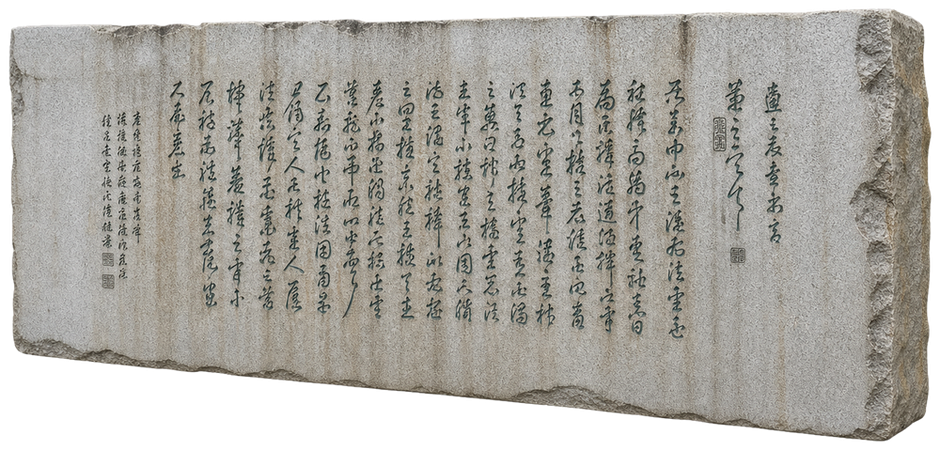
Yao Tuo, originally from Luzhuang, Gongyi, Henan, was born Yao Tianping and also used the name Yao Kuang. He was a renowned writer and calligrapher. He graduated from the Central Military Academy in China and served as publisher and chief editor of Chinese Students Weekly, University Life, Students Weekly, and Chao Foon Monthly. He was one of the founders and advisers of the Malaysia Calligraphy Association. In his early years he studied Wang Xizhi and was later influenced by Pu Ru. His strokes are firm, elegant, and vigorous; large and small characters alternate with continuous momentum, linked movement, rich variation, and natural fluency. Through diligent practice he gained deep skill, and the clear rhythm within his relaxed manner reflects a cultivated artistic spirit. He summarized his life with the words: ?I devoted all my talent to cultural work and never boasted of personal achievement.?
Pan Huang
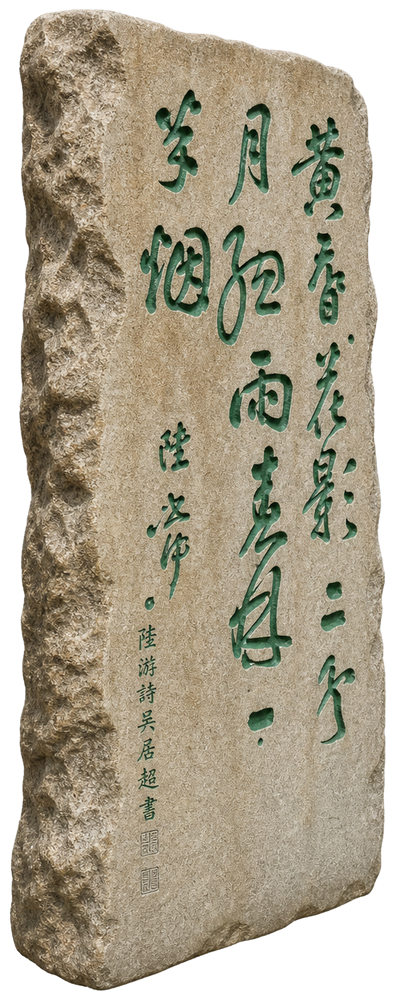
Pan Huang, originally from Kaifeng, Henan, courtesy name Xingruo, taught at Sibu Chung Cheng Secondary School and served as principal of Kai Wen Secondary School in Bintangor and Jian Xing Secondary School in Sibu. He published Collected Calligraphy of Pan Huang. He studied calligraphy under Fu Juanfu and Sun Qifeng, striving to make his lines rounded and to contain the brush force within them. Like clouds moving and rain falling, his brushwork flows without slipping, with grand momentum and lingering resonance.
Huang Run Yue
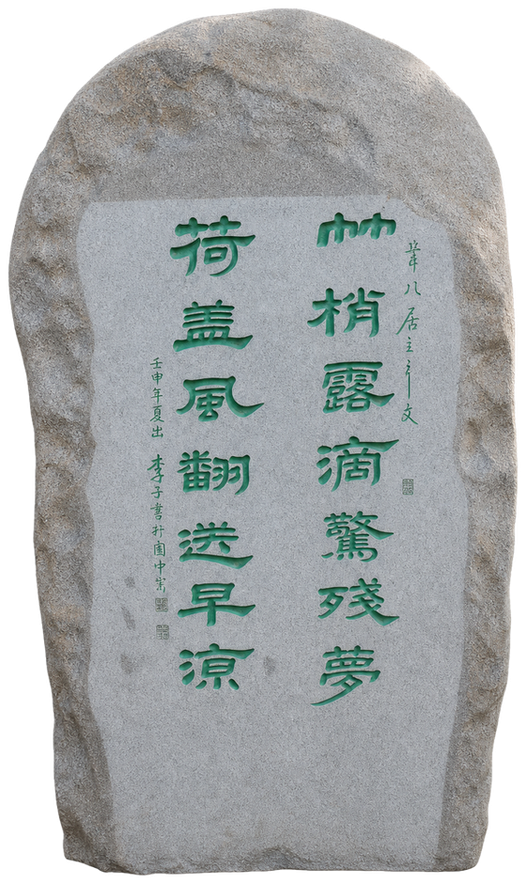
Huang Run Yue, originally from Changsha, Hunan, was an educator, writer, and poet. He served as principal of Xin Wen Long Chinese High School in Rengit, Johor, chairman of the United Chinese School Teachers? Association of Malaysia, and principal of Pay Fong High School in Malacca. In his later years he devoted himself to religious activities. His early calligraphy followed Qing calligrapher Qian Nanyuan, and later he studied the Han Zhang Qian Stele and Yi Ying Stele. Written in clerical script, the Zhen Zhong Pavilion Inscription for Xin Wen Long Chinese High School contains several hundred characters and is a grand work. The brushwork is like slanting rain in a crosswind; the lines respond fluidly to one another. Dense areas are not cramped, and open areas are not empty, giving the work a natural subtlety.
Chen Lei Shi
Chen Lei Shi, originally from Chao?an, courtesy name Botong, was an internationally renowned guqin master, writer, and calligrapher. He taught at Chung Ling High School in Penang and Chung Hwa High School in Muar, Johor, and later served as professor at Chinese Culture University in Taiwan and the Chinese University of Hong Kong, where he was also curator of the Chinese Music Archive. He wrote A Glimpse of Travels in Europe. His calligraphy began with Wei steles and later advanced into Han clerical script, especially the Zhang Qian Stele. It has a lingering charm and belongs to the literati style.
Du Cun Li
Du Cun Li was born in Tainan, Taiwan, and was ancestrally from Longxi County, Fujian. In 1937, he came south to Malaya and served as principal of Sepang Nan Chiau School and physical education director of Singapore Tao Nan School. Du devoted his life to the study of calligraphy and was skilled in seal, clerical, running, cursive, and regular scripts. After the 1990s, he focused his energy on teaching calligraphy. His style continued the lineage of the Tang Yan-style Yuanjie Stele, while his characters show the flavor of Qing calligrapher Hua Shikui. He also enjoyed gripping cotton soaked with ink in his palm and writing with his fist instead of a brush.
Huang Yao
Huang Yao, originally from Zhejiang, was an internationally renowned cartoonist. He lectured at Jinling, Nankai, and Fudan universities. In the 1930s, he became famous across China for his Niu Bizi cartoons. He settled in Malaya in 1956 and held educational cartoon exhibitions. He served for many years as principal of Sin Min Independent High School and was one of the founders and advisers of the Malaysia Calligraphy Association. He held a folk painting exhibition in Kuala Lumpur in 1981, a porcelain painting exhibition in Kuala Lumpur in 1985, participated in the Fourth International Calligraphy Exhibition in 1983, and in the Fifth International Calligraphy Exhibition in Japan in 1984. Huang Yao possessed deep learning in literature and philosophy. His calligraphy and painting were forward-looking and highly personal, pioneering modern calligraphic art. His character-paintings and Chuyun script opened new paths; he could even write upside down across a table. His ink painting style was also distinctive, blending local folk culture with the essence of Chinese culture, making him a remarkable figure in modern Chinese ink painting.
Zhou Man Sha
Zhou Man Sha, originally from Changsha, Hunan, graduated from Hunan First Normal College. He was an educator, calligrapher, and seal carver, and in his later years used the sobriquet Xintian Weng. He was one of the founders and advisers of the Malaysia Calligraphy Association, and also one of the founders of the Penang Art Society. For many years he served as general affairs and cultural-education director of the Penang Chinese Town Hall. He taught at Changsha Literary Arts Secondary School. In May 1937, he came south to Penang and became principal of Yuk Choy School in Kedah. Together with Ren Yu Nong, he founded Nanfeng Magazine, using it to critique current affairs and promote resistance against Japan, gaining recognition in northern Malaya. In 1945, he took charge of Ming Der School, planning its development with great effort and earning a strong reputation; in 1958, he founded a Ming Der branch school. His calligraphy is vigorous in brush strength and refined in style.