Malaysia Chinese Calligraphy Stone Gallery
Curated Collection
让典藏不只是一种展示,也成为一种漫游与凝视。在这里,每一道刻痕都是时间的低语,带您走入汉字演变的浩瀚长河。
Master Bo Yuan
Master Bo Yuan was from Fu?an, Fujian. His secular surname was Li and his given name was Defu. At nineteen, he left home under Chan Master Jingsheng at Guanghua Temple on Lion Peak. At twenty, he received full ordination under Chan Master Xuyun at Yongquan Temple in Gushan, Fuzhou, then entered Shigu Buddhist College and later served as guest-master in the Gushan monastic community. After coming south in 1947, he served as superintendent of Kek Lok Si Temple in Penang and permanent adviser to the Malaysian Buddhist Association. His calligraphy formed a style of its own, vigorous and majestic like the Diamond Sutra inscriptions of Mount Tai. Grounded in stele methods, it is expansive, unrestrained, and enhances the sculptural and overall beauty of stele learning while expressing the tranquil transcendence of monastic calligraphy.
Elder Zhu Mo
Elder Zhu Mo, originally from Yueqing, Zhejiang, used the sobriquet Monk of Yandang Mountain. His secular surname was Chen and his given name was De?an. He was an eminent monk of his generation. In 1928, he received ordination from Master Dixian at Guanzong Temple, studied Buddhist doctrine under Master Taixu, and studied painting and calligraphy under Gao Jianfu of the Lingnan school. During the Sino-Japanese War in 1937, he took refuge in Hong Kong and Macau, promoted Buddhism, and edited The Awakened One and Endless Lamp magazines. In May 1954, he arrived in Penang and taught at Bodhi School. In 1959, he led the founding of the Malaysian Buddhist Association and was elected its first chief, serving for many terms. In 1969, he initiated the Malaysian Buddhist Institute and served as its dean for many years. In 1998, he was conferred a datukship by the Governor of Penang. He served as adviser to the Malaysia Calligraphy Association and the Malaysian Buddhist Association. Publications include Collected Calligraphy and Paintings of Master Zhu Mo and Seal-Fragrance Studio Calligraphy and Paintings. Elder Zhu Mo excelled in epigraphy, calligraphy, painting, poetry, and prose. His calligraphy is admired for refined spirit, effortless composition, and a detached elegance in which every stroke is alive and every aspect natural.
Shen Mu Yu
Shen Mu Yu was a renowned defender of Chinese education in Malaysia. He served as chairman of Dong Zong, adviser to the Malaysia Calligraphy Association and the Malaysian International Modern Calligraphy and Painting Alliance, and president of the Malacca Confucian Association. He was also the first overseas Chinese recipient of Taiwan?s Administrative Cultural Award. He served as principal of several schools in Malacca, including Malacca Public First Primary School, Pay Teck Primary School, Pay Fong Primary School No. 1, Ping Min Primary School, and Chen Zhong Night School, and was listed in the Malaysia Book of Records as the country?s longest-serving principal. The Cheng Ho Cultural Museum in Malacca established the Shen Mu Yu Calligraphy Gallery in 2007, and the Shen Mu Yu Calligraphy and Cultural Relics Museum opened in Malacca in 2011. His style takes Yan as its structural bone and Zhao and Liu as its outward form, dignified, majestic, and powerful. His structures are compact and dense, his lines thick and full, and his brushwork steady and forceful. His distinctive style is known as the Shen style.
Xiao Yao Tian
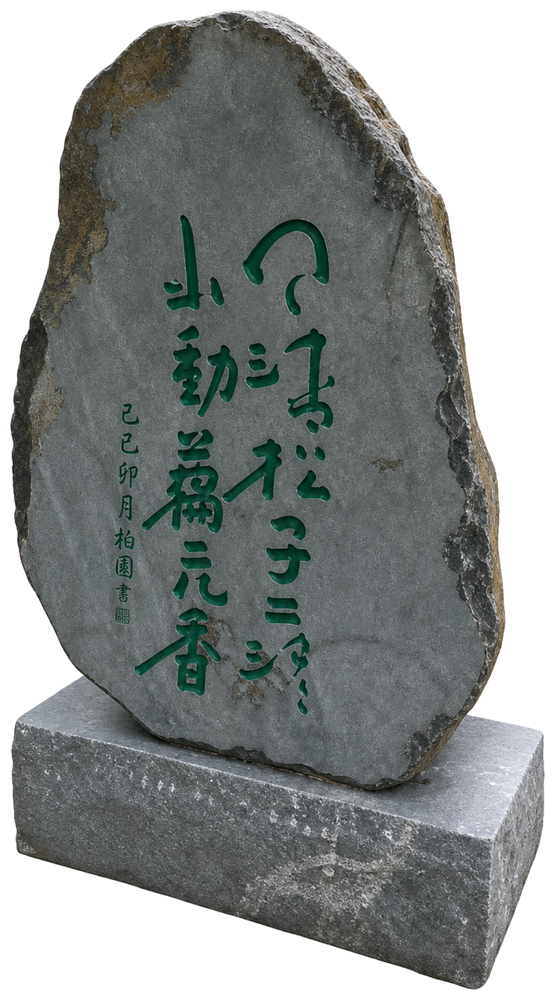
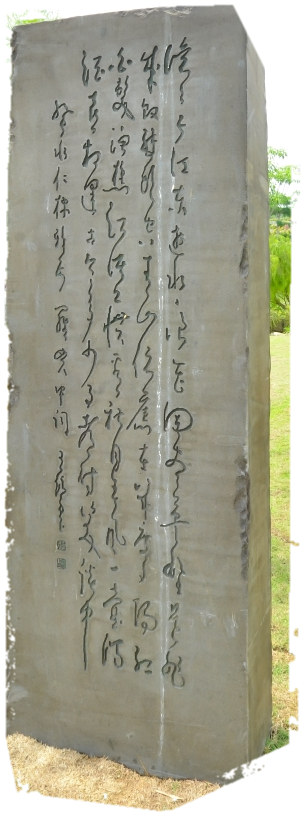
Xiao Yao Tian, originally from Chaoyang, was a renowned Teochew writer and calligrapher in Hong Kong, Malaysia, and Singapore. He served as associate professor at Nanhua University, teacher and head of the Chinese Department at Chung Ling High School in Penang, and curriculum committee member of the Ministry of Education of the Federation of Malaya. Beginning in 1960, he spent thirteen years as chief editor of Teaching and Learning Monthly, which became widely read throughout the peninsula. In his early years he studied many stele and model-book traditions; later he favored cursive script and often blended stele and model-book methods. This banner was written with concise and agile zhangcao technique.
Pan Shou
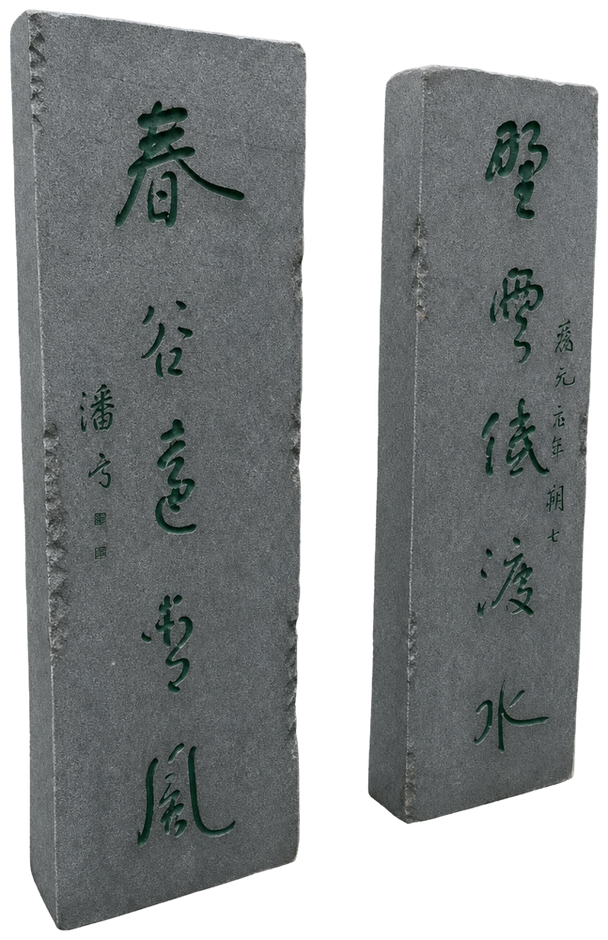
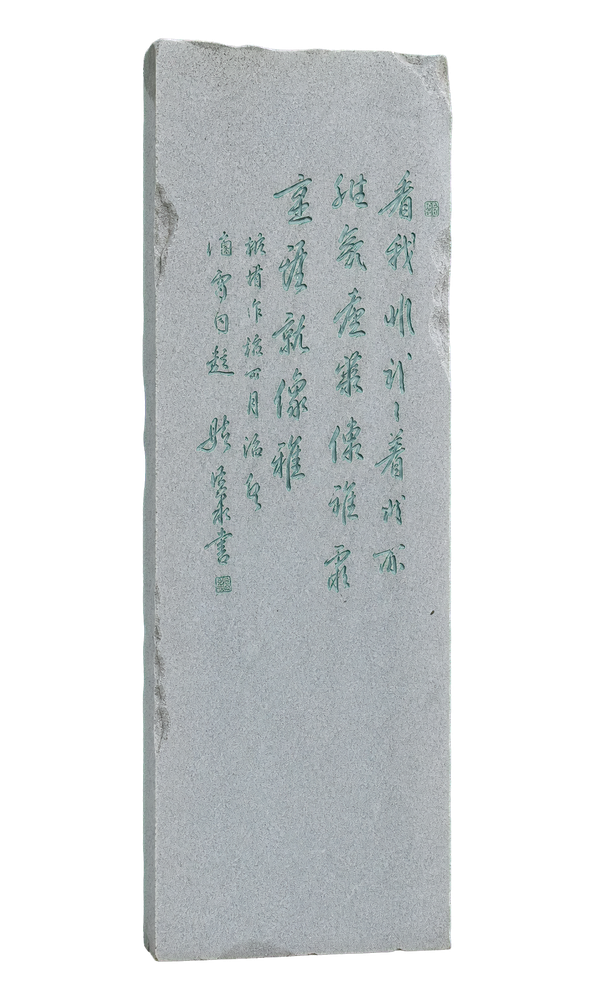
Pan Shou, originally from Nan?an, Fujian, was formerly named Guoqu and used the sobriquet Kanyun Weng. He was a calligrapher, poet, and honorary doctor of Nanyang Technological University. He served as secretary-general of Nanyang University, editor of Lat Pau, principal of Chung Hwa High School in Muar, Johor, and secretary-general of the Nanyang China Relief Fund during the War of Resistance, when Tan Kah Kee served as chairman. Pan wrote with a suspended wrist and centered brush, producing a vigorous, archaic, natural, and elegant style. Yu Pingbo described his calligraphy as bold and free; Qian Zhongshu also praised it as archaic, charming, refined, and elegant, integrating seal and clerical elements into running and cursive scripts.
Ren Yu Nong
Ren Yu Nong, courtesy name Xiangpu, was ancestrally from Changsha, Hunan. He was a writer and poet, and graduated from the History Department of Hunan First Normal College. He taught at Liling Women?s Normal School in Hunan. In 1938, he co-founded Nanfeng Magazine with friends and served as editor-in-chief. After Japan?s surrender, he taught at Pei Hwa Chinese School in Beihai, Chung Ling High School in Penang, Taiping Hua Lian High School, and the Language Institute and Teachers? College in Kuala Lumpur as a lecturer in classical Chinese literature. In 1985, he co-founded the Malaysia Calligraphy Association and served as adviser. He received the Honorary Cultural Award from the Malaysian Chinese Cultural Association and was appointed honorary professor by Shaanxi Normal University in China. His calligraphy has an orchid-like refinement, graceful and elegant, complementing the character of his poetry and prose.
Zheng Yi Feng
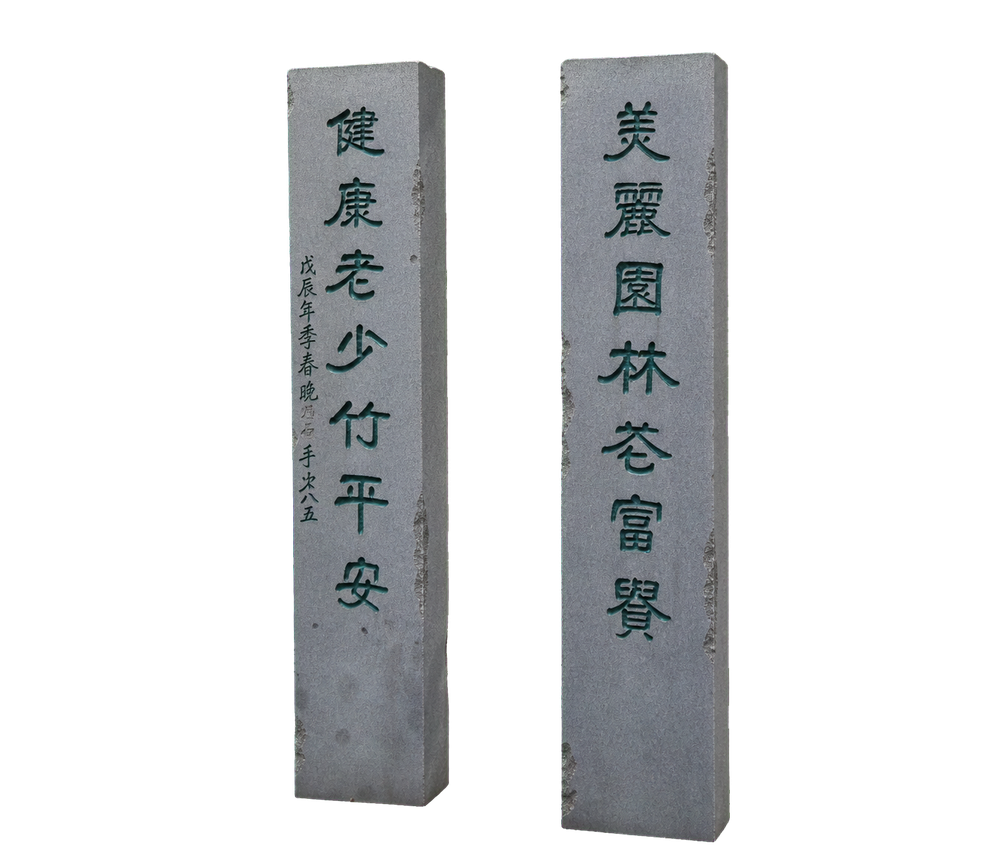
Zheng Yi Feng was originally from Minhou, Fujian, China. He graduated from Fujian College in China. During the Sino-Japanese War, he served as a war correspondent, and after the restoration he came south to work in education. He was principal of Sin Min Primary School in Sungai Petani, Kedah, and Xinhua Primary School in Parit Buntar, Perak. He was skilled in many script styles. This couplet carries the structural spirit of Sui steles; although written in running script, it still shows a forged strength and imposing presence.
Chen Ren Hao
Chen Ren Hao was originally from Fu Zhou, Fu Jian. Graduated from Shanghai Xinhua University of Art, Chen was a postgraduate researcher of Academy of Arts, Paris. He lectured at Shanghai Training School of Fine Arts prior to leaving his footprints in Southeast Asia as the principal of Chung Hwa High School (Muar) and Dunman High School (Singapore). Chen’s works exude the calligraphy characteristics of a typical scholar. He drew inspiration from the calligraphy styles of Song and Yuan dynasties, followed by immersion in tablet calligraphy. One may feel the vigorous pulses in his calligraphy, along with masculinity and femininity, harmoniously.
Luo Qing Quan
Hailed from Hui An, Fu Jian, Luo Qing Quan was the leader of the overseas Chinese community in Penang. A notable figure who laid the foundations for the blossoming of Chinese culture and education across Penang from the beginning of the 20 th century until 1960s, Luo stamped his mark on the literary fraternity with his impressive poetry and essay pieces. Together with the like-minded fraternity members, Luo founded the Penang Poem Reading Society and Penang Art Society. He was dynamic figure in the movement of literature and art in which Penang was known as the epic centre of art in those days. Luo was a close friend of Chinese calligraphers of the modern era in the likes of Xu Bei Hong and Zhang Da Qian. Luo had a brilliant command of calligraphy and seal carving, drawing inspiration from Huang Ting Jian. The composition of his calligraphy can be likened to the swift movement of a mighty sword, stately and sturdy. It leads you to a scholarly world filled with endless literary adventures, so well-cultured and elegant. His calligraphy works represent a personality of himself, being a gentleman of scholarly bearing.
Shi Xiang Tuo
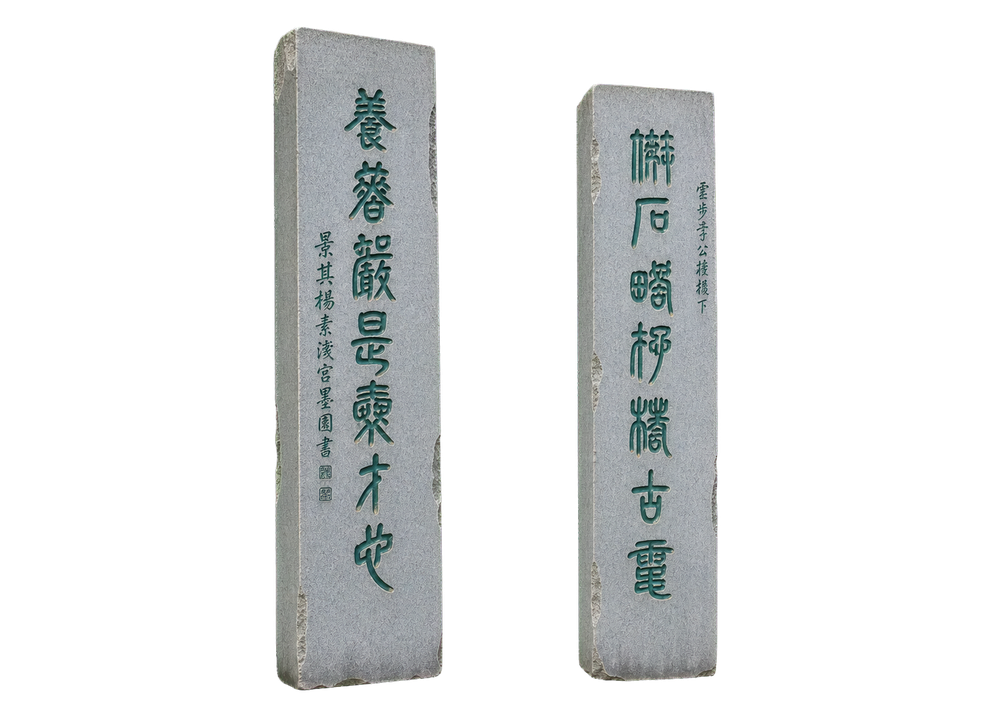
Shi Xiang Tuo is also known by his other given name of ‘Shi Hong Ze”. Hailed from Zhang Zhou, Fu Jian and born into a scholarly driven family where his forefathers were adept at calligraphy and painting, Shi came to Singapore in 1938. He was appointed the principal of Nanyang Academy of Fine Arts in Singapore in 1941, a post he held for 39 years. Throughout his life, he dedicated himself to mastering the art of the ancient tablet-based calligraphy through endless diligent studies. Shi therefore specialized in ‘Zhuan Shu’ calligraphy, which is a form of ancient calligraphy. His ‘Zhuan Shu’ calligraphy is simply fascinating, not to mention his Zhuan-based, Han Dynasty-inspired seal carving. Shi’s works ooze vintage elements, cheerfulness, high-spiritedness and ingenuity. The multi-talented Shi left a long-lasting legacy of literary art through his marvelous calligraphy, painting and seal carving. His masterpieces are a fusion of his lifelong ideas delivered through his dexterity. What you see is a lifelong literary journey presented by his brushes and carving chisels and cutters. Shi was exceptionally good at producing calligraphy and painting pieces inspired by the raw beauty of ancient seal carving. His works appear to be in a very commanding and confident mood, earning him a place in the hall of fame for the grand masters. Shi himself was an erudite scholar who in his lifetime, blessed the literary fraternity with plenty of great works. He devoted his life to the teaching of art, sowing literary seeds across Singapore and Malaysia.
Wang Rui Bi
Wang Rui Bi hailed from An Xi, Fu Jian. He was once the Director for Public Affairs, Divisional Head and Principal at Li Zhong High School in An Xi, Fu Jian for a duration of 16 years. He later became the principal of Kluang Chong Hwa High School (Johor) and Kuala Lumpur Chung Hwa Independent School after migrating to Malaya. Wang was an adept calligrapher who favoured Cao Shu and Kai Shu calligraphy. He published a significant four-topic book on calligraphy that delves into “Rui Bi Han Mo” (ink), “Rui Bi Zhi Shu” (calligraphy styles), “Rui Bi Bi Yi” (calligraphy brushes) and “Zhi Mo Di Er Ji” (The ‘Second Volume’ on Calligraphy). Wang’s calligraphy is driven by the Cao Shu style (cursive/ grass script). It features no dramatic drags and curves, yet, delights with a balanced ‘tights’ and ‘looses’. Overall, his calligraphy aims to take away the travesty of messiness. It presents a fluid and elegant profile through a well-composed simplicity and naturalness with affection and spontaneity at ease.
Li Xiu Tian
Li Xiu Tian was the principal of Chung Hua Middle School in Sarawak. He held other teaching roles at Seremban Chung Hua High School, Ipoh Yuk Choy High School and Chung Hwa Independent High School (Kuala Lumpur) for a duration of over two decades. He first established his calligraphy classes in 1955. Upon his retirement from teaching in the 80s, he focused on spreading his calligraphy knowledge for the rest of his life. He was conferred the highest cultural honour by the Malaysian Chinese Cultural Society in the inaugural award ceremony. Li’s calligraphy is well-constructed and steady; well-ordered and neat.